

We’ve been installing garage doors across Central Ohio since 1996. Over nearly three decades, we’ve walked through hundreds of attached garages in Marion, Marysville, and Delaware, where a single, uninsulated door was responsible for a dramatic temperature drop that the homeowner’s furnace worked overtime to combat. The fix was simpler and more impactful than most people expect.
This guide gives you the full picture: what insulated garage doors actually do, how they perform in Ohio winters specifically, what to look for when comparing options, and the signs that it’s time to make the switch.
Insulated garage doors reduce heat transfer between your garage and the outside, helping stabilize indoor temperatures and lower the burden on your home’s heating system. In Ohio’s climate, where winters are long and temperatures regularly dip below freezing, an insulated door on an attached garage has a direct, measurable impact on your energy bills and home comfort.
What Insulated Actually Means
A standard garage door is a single layer of steel or aluminum. It separates the inside of your garage from outside air, but only barely, the way a thin curtain separates a room from a drafty window.
An insulated garage door adds one or two layers of material, typically polystyrene or polyurethane foam, sandwiched between steel panels. This creates a thermal barrier that slows heat transfer in both directions: it keeps warm air in during winter and keeps heat out during summer.
The measure of that barrier is called the R-value. The higher the R-value, the more resistant the door is to temperature transfer. For Ohio homes, especially attached garages, a higher R-value isn’t a premium upgrade; it’s the practical baseline, something we emphasize at The Door Guys when helping homeowners choose the right garage door.
The Real-World Impact on Ohio Energy Bills
We won’t throw out specific numbers; energy savings vary based on your home’s layout, insulation elsewhere, and how your HVAC system is set up. But we can tell you what we see consistently on projects here in Marion.
When we replace an older, non-insulated door on an attached garage, homeowners almost always report the same things within the first week: the garage feels noticeably warmer, the room adjacent to the garage (often a kitchen or laundry room) no longer feels drafty, and the furnace isn’t cycling on as frequently. The physics are straightforward; less heat escaping means the system runs less to maintain the same temperature.
Ohio’s winters aren’t brief. Marion averages around 28 inches of snowfall per season and regularly sees temperatures in the single digits. Every uninsulated square foot of garage door surface is exchanging heat with the outside air for months at a time. That accumulates.
Five Benefits That Go Beyond Energy Savings
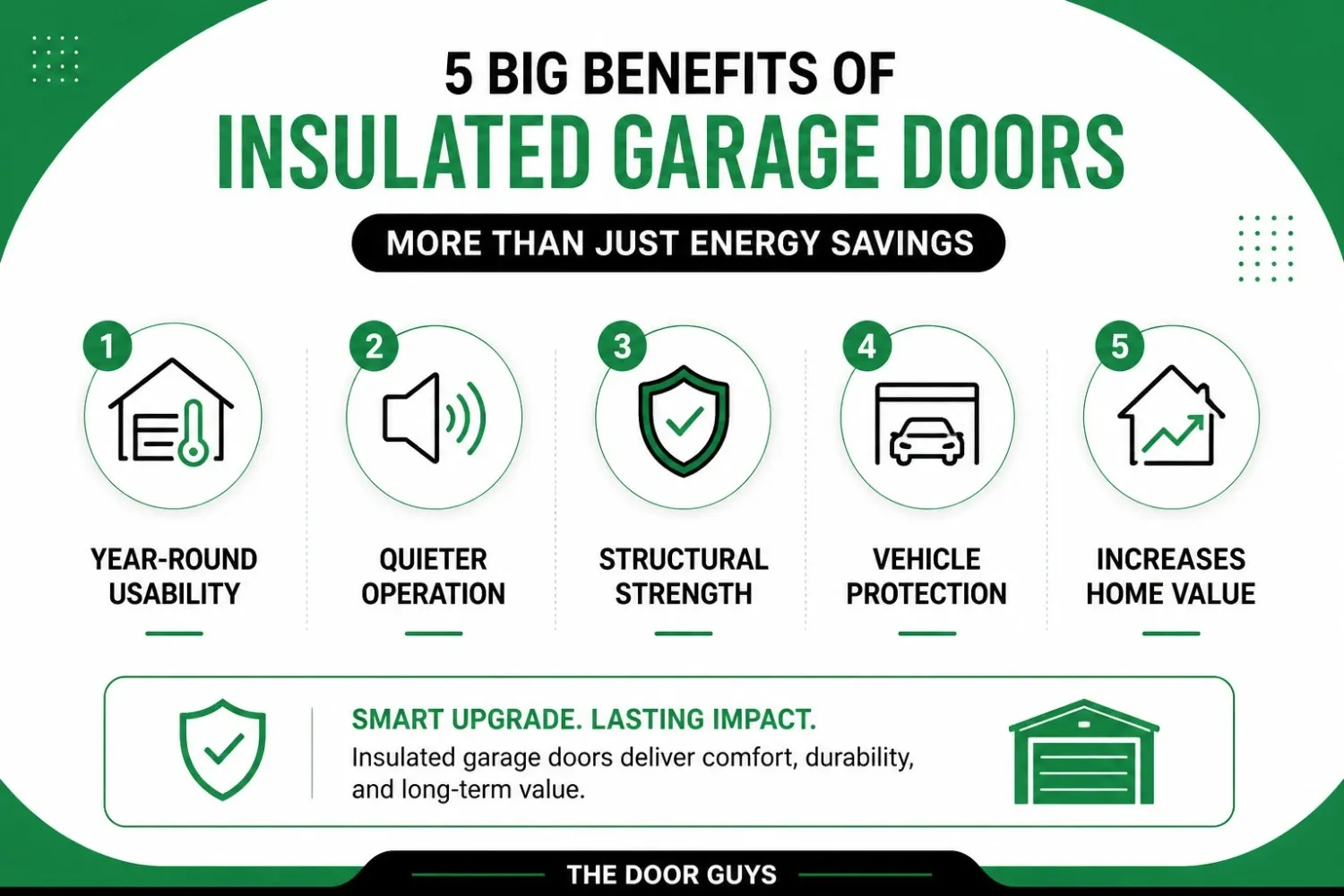
An insulated garage becomes a usable workspace even in February, not just a freezing pass-through.
The foam core absorbs vibration. Multi-layer insulated doors are noticeably quieter during daily use, a meaningful upgrade for bedrooms above or adjacent to the garage.
Insulated doors, particularly polyurethane-filled ones, are more rigid and dent-resistant than single-layer alternatives. They hold up better against Ohio wind and minor impact.
A temperature-stabilized garage extends battery life, keeps fluids from thickening in winter, and protects your vehicle’s finish year-round.
Energy-efficient upgrades increasingly show up in home listings. A quality insulated door signals a well-maintained, thoughtfully improved property to Ohio buyers.
Insulated vs. Non-Insulated: Side-by-Side Comparison
| Feature | Insulated Door | Non-Insulated Door |
|---|---|---|
| Thermal barrier (R-value) | High | Minimal or none |
| Temperature stability | Consistent | Fluctuates with outside temp |
| Noise during operation | Quieter | Noisy, more vibration |
| Structural rigidity | More rigid, dent-resistant | More prone to warping |
| Long-term durability | Higher | Lower |
| Heating system strain | Reduced | Elevated |
| Best for attached garages? | Strongly recommended | Not recommended |
What Makes Ohio Winters Different: and Why It Matters for Garage Doors
Ohio sits in the upper Midwest climate zone, which means sustained cold, not just occasional freezes. Marion, in particular, experiences weeks at a time where daytime highs don’t break the 20s. Garage doors in this environment aren’t just enduring cold snaps; they’re managing a persistent thermal challenge for four to five months of the year.
That sustained exposure is what separates Ohio from states where insulation is a nice-to-have. Here, a non-insulated door on an attached garage is essentially an open thermal exchange running continuously through winter. It’s also worth noting that Ohio summers bring humidity and heat that work in the opposite direction; a well-insulated door helps in July, too.
Can You Get a Tax Credit for Upgrading Your Garage Door in Ohio?
This is one of the most common questions we get, and the honest answer is: it depends on the specific product. The Energy Efficient Home Improvement Credit (25C), administered by the IRS, covers certain energy-efficient home upgrades. Garage doors are listed as an eligible category when they meet specific energy efficiency requirements set by the ENERGY STAR program.
We recommend checking the current IRS 25C guidelines directly and confirming with your tax advisor whether the specific door you’re considering qualifies. Some of the products we install do meet these standards. Our team can share product specs to help you or your accountant make that determination. Just ask when you reach out for an estimate.
Signs It’s Time to Replace Your Current Garage Door
You don’t always need to wait for a door to break down to justify a replacement. In our experience, these are the clearest signals that an upgrade will make an immediate difference:
- The garage temperature drops dramatically as soon as outdoor temps fall, even with the door closed
- The room inside your home that shares a wall with the garage is noticeably colder than the rest of the house
- Your door is a single-layer steel or hollow-core model that was standard 15–20 years ago
- You can see daylight through gaps around the door’s perimeter
- The door rattles significantly during operation or in the wind
- You’ve noticed your heating bills are climbing without another obvious explanation
- You’re planning a broader home improvement project and want to address efficiency at the same time
If two or more of these apply to your home, the conversation about upgrading is worth having. Our garage door installation process is straightforward, and we can assess your current setup and make an honest recommendation during a free estimate, no pressure, no upselling.
Why Installation Quality Determines Whether Your Door Actually Performs
A high R-value door installed with gaps in the perimeter sealing, an uneven floor contact, or misaligned tracks won’t deliver on its thermal promise. The insulation in the door panel is only one part of the equation; the installation itself determines whether that insulation actually creates a closed system.
This is where working with a local team that knows Ohio conditions matters. We’ve seen doors from reputable manufacturers underperform because the installation didn’t account for an uneven concrete floor or a door frame that had shifted over the years. Getting it right requires experience with the specific variables that Marion-area homes present.
If you’re considering a full door replacement, not just a panel swap, our door retirement and replacement service walks through the full process, from selecting the right product to a clean, properly sealed installation.
Written by The Door Guys Team: Marion, Ohio
The Door Guys has served Central Ohio homeowners since 1996 from our location at 793 N Main St, Marion, OH 43302. We offer free estimates, 24/7 service, and straightforward advice, no upselling, no unnecessary replacements. This article reflects what we see daily on real projects across Marion, Delaware, and Marysville.
Frequently Asked Questions
Q.1 Is an insulated garage door worth it if my garage is detached?
For detached garages, the case for insulation is weaker than for attached garages. Because a detached garage doesn’t share walls with your living space, heat loss there doesn’t directly affect your home’s heating system. That said, if you use your detached garage as a workshop or spend significant time in it during winter, insulation still makes the space more comfortable. We typically recommend prioritizing insulation on attached garages first.
Q.2 Where does a garage lose the most heat in an Ohio winter?
The garage door itself is the largest opening and typically the biggest source of heat loss, especially in older homes where the door is a single layer of steel with no insulation core. After the door, the biggest culprits are the perimeter gaps (where the door meets the frame and floor), unsealed ceiling penetrations, and uninsulated walls shared with the house. Fixing the door is almost always the highest-impact first step.
Potentially, yes. The IRS Energy Efficient Home Improvement Credit (Section 25C) includes exterior doors, including garage doors, when they meet specific ENERGY STAR efficiency thresholds. The credit and its requirements can change year to year, so we recommend verifying current eligibility with the IRS website or a tax advisor. We can provide product spec sheets to support that conversation.
For most residential installations in Marion and surrounding areas, a full garage door replacement takes between two and four hours. That includes removing the old door and hardware, installing the new door system, testing the springs and opener operation, and verifying the perimeter seals. More complex installs, larger openings, custom sizing, or opener replacements may take longer. We’ll give you a realistic time estimate when we schedule your installation.
Does an insulated garage door also help in Ohio summers?
Yes. The same thermal barrier that keeps winter cold out also keeps summer heat from entering your garage. Ohio summers bring high humidity and sustained heat, and an insulated door helps keep your garage cooler, which matters both for comfort and for protecting stored items, vehicles, and anything temperature-sensitive you keep in the space.
The Bottom Line for Ohio Homeowners
If your garage is attached to your home and your current door isn’t insulated, you’re running a persistent energy leak through one of Ohio’s longest winters, often without realizing it. The upgrade to an insulated garage door isn’t complicated, and for most Marion-area homes, the impact is noticeable from the first cold week.
The key is getting the right door for your specific garage setup and having it installed correctly so the insulation actually creates a closed, sealed system. That’s what our team has been doing across Central Ohio for nearly 30 years, and it’s a conversation we’re happy to have for free.