
Most homeowners never think about their garage door springs until the door refuses to open one morning. That loud bang you heard in the garage at 6 AM? That was probably a spring letting go.
If you want to avoid that scenario entirely, understanding garage door spring life expectancy is one of the most practical things you can do as a homeowner. Not because you’ll be replacing them yourself (please don’t more on that below), but because catching early warning signs can save you from a complete system failure and a much bigger repair bill.
How Long Do Garage Door Springs Last?
Most standard residential garage door springs are rated for 10,000 cycles. One cycle = one full open and one full close. For the average household using the garage door 3–4 times per day, that works out to roughly 7 to 9 years. High-cycle springs rated at 25,000 or 50,000 cycles can last significantly longer.
That said, “average” can be misleading. A family of five using the garage as their main entrance might hit 10,000 cycles in four years. A retired couple who park in the driveway most of the time might get 15 years out of the same spring. Cycle count matters far more than the calendar.
Torsion Springs vs. Extension Springs: Does It Matter for Lifespan?
Yes, it does, and it’s worth knowing which system you have.
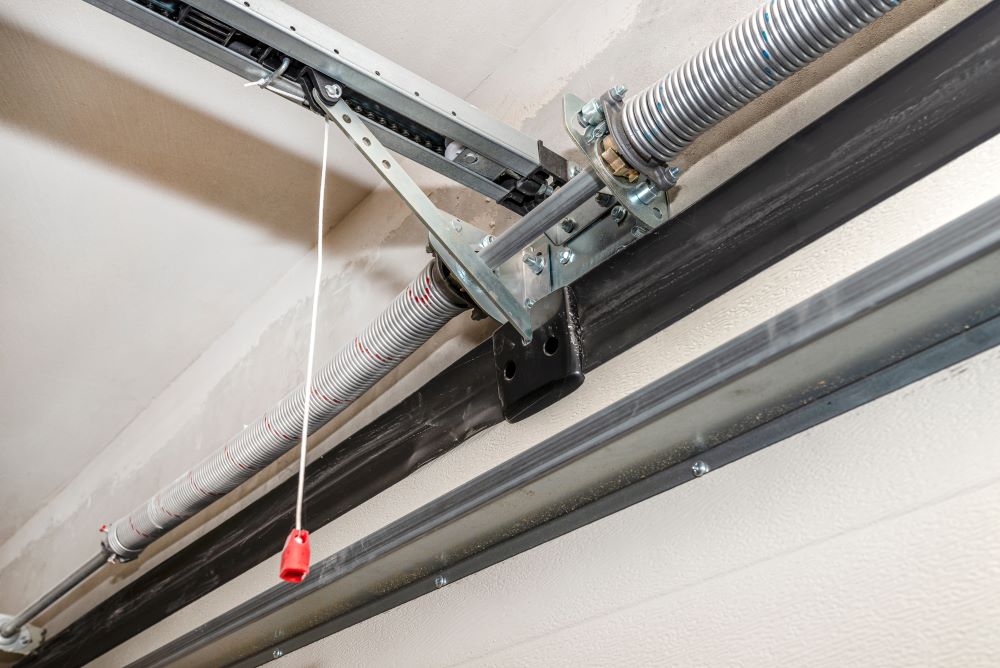
Torsion springs sit horizontally above the garage door opening. They wind and unwind to lift and lower the door. Because the movement is controlled and centered, torsion springs tend to handle stress more evenly and generally have a longer service life. Most modern residential doors use torsion spring assemblies, and for good reason.
Extension springs run along the horizontal tracks on either side of the door. They stretch and contract with each cycle. That stretching motion creates more wear at the attachment points over time, and extension springs typically show signs of fatigue sooner than torsion systems.
If your home was built more than 20 years ago and the springs have never been replaced, there’s a reasonable chance you have extension springs and an equally reasonable chance they’re overdue for an inspection.
What Actually Wears Springs Out Faster
Cycle count is the biggest factor, but it’s not the only one. Several conditions can shorten garage door spring life expectancy well below the rated number:
Lack of lubrication. Metal-on-metal friction builds up heat and accelerates wear. Springs that haven’t been lubricated in years can fail significantly earlier than their rated cycle life.
Temperature extremes. If your garage isn’t insulated, Ohio winters put real stress on metal components. Repeated expansion and contraction weaken the coil structure over time.
Incorrect spring sizing. A spring that’s undersized for your door’s weight is working harder on every single cycle. This is a common problem after DIY door panel upgrades, where the counterbalance system wasn’t recalculated.
Rust and corrosion. Humidity, especially in garages near humid basements or without proper ventilation, causes surface rust that weakens the spring and increases friction.
Heavy door panels. Wood doors, thick insulated steel panels, and some composite doors are significantly heavier than standard doors. If your spring was sized for a lighter door, your cycle life drops.
Warning Signs Your Garage Door Springs Are Wearing Out
Springs rarely snap without giving you some warning first. The problem is that the signs are easy to dismiss or misattribute to the opener. Here’s what to actually watch for:
The Door Feels Unusually Heavy
Disconnect the automatic opener and try lifting the door manually. A properly balanced door with functional springs should feel relatively light. You should be able to lift it with one hand, and it should stay in place when you let go midway.
If it feels like you’re lifting dead weight, or if it falls back down the moment you release it, the springs are no longer carrying the load they’re supposed to.
One Side Is Lower Than the Other
If the bottom of your garage door isn’t level when it closes, one corner sits lower, or the door “walks” sideways during movement, that’s a balance problem. This often means one spring has lost tension while the other is still functional, creating an uneven counterbalance.
The Door Moves Jerky or Hesitates
A door with healthy springs should move smoothly and consistently from bottom to top. If it stutters, slows mid-travel, or seems to take a moment to “catch,” that’s a sign the spring tension is uneven or declining.
Your Opener Is Working Harder Than It Used To
Openers are designed to assist a balanced door, not do all the heavy lifting themselves. When springs weaken, the opener motor compensates. You might notice slower operation, louder motor noise, or the opener struggling to pull the door up at all. Many homeowners assume the opener is failing when the springs are actually the problem.
A Loud Bang or Snap
When a torsion spring fails, it releases all its stored tension at once. The sound is jarring; many homeowners describe it as a gunshot going off inside the garage. If you hear this and your door suddenly won’t open, don’t try to force it. The door is now unsupported.
A Visible Gap in the Spring Coil
Check your torsion spring (the coil above the door). If you can see a separation in the coils, a gap where there shouldn’t be one, the spring has broken. This is a do-not-use situation until a technician can replace it.
A Real Scenario We See Regularly
At The Door Guys, we’ve been serving Central Ohio homeowners since 1996, and one call we get frequently goes something like this: a homeowner has been noticing their garage door getting slower and harder to open over the past few months. They assumed the opener was going bad. By the time they called us, the opener motor was overheating because it had been compensating for failing springs for weeks.
After inspecting the balance and spring assembly, we found the springs were well past their useful cycle life, but the opener had also taken on unnecessary wear. A simple spring inspection earlier in the process would have prevented the opener from being stressed at all.
That’s why we always recommend checking both systems together. If your springs are aging, your opener is probably feeling it too.
The Balance Test: A 30-Second Check You Can Do Today
Here’s a quick way to gauge whether your spring system is still doing its job:
- Close the garage door fully.
- Pull the red emergency release cord to disconnect the opener.
- Manually lift the door to about waist height and let go.
A well-balanced door will stay roughly in place. If it falls to the ground or shoots upward, the springs are either broken or significantly out of balance. Either way, that’s a sign it’s time for a professional inspection.
Should You Replace One Spring or Both?
This is one of the most common questions we hear, and the answer in most situations is: replace both.
Here’s the logic. If you have two springs and one has failed, the other one has been running the same number of cycles. It’s under the same amount of fatigue. Replacing only the broken spring means the surviving spring could fail within months, and you’re paying for another service call.
Replacing both at the same time is almost always the more cost-effective decision in the long run, and it restores balanced tension across the full door width.
Why Spring Replacement Isn’t a DIY Job
We’ll be direct about this: garage door spring replacement is one of the few home maintenance tasks where DIY is genuinely dangerous, not just inconvenient.
Torsion springs are wound under extreme tension. If a spring slips, breaks, or releases unexpectedly during replacement, it can cause serious injury. The cable drums, winding bars, and the process of tensioning the spring correctly all require training and the right tools.
This isn’t a liability disclaimer; it’s a practical warning based on years of seeing what happens when it goes wrong.
Extending Spring Life: What Actually Helps
You can’t stop springs from wearing out, but you can slow the process:
Lubricate twice a year. Use a garage door-specific lubricant (not WD-40) on the spring coils in spring and fall. This reduces friction and helps protect against rust.
Schedule an annual inspection. A technician can check spring tension, cable condition, balance, and hardware before small issues compound. Many problems are far cheaper to address before they cause a failure.
Don’t force the door. If the door is struggling, don’t keep running the opener, hoping it works itself out. That strains both the opener and the springs. Call for service.
Keep the garage ventilated in humid months. Reducing moisture in the garage extends the life of all metal components, including springs.
Serving Marion, Powell, and Central Ohio
If your garage door is showing any of the warning signs above, or if it simply hasn’t been inspected in a few years, The Door Guys is available Monday through Friday, 8 AM to 5 PM. We also offer 24/7 emergency service for complete spring failures.
Frequently Asked Questions
Q.1 Can my garage door springs fail even if they look fine on the outside?
Yes. Internal metal fatigue is the most common cause of spring failure, and it’s not visible. A spring can look intact and still be operating at a fraction of its original tension. If your door is behaving strangely, don’t rely on visual inspection alone; a balance test or professional check will tell you more.
Q.2 How do I know if my garage door opener is failing or if it’s actually the springs?
Disconnect the opener and lift the door manually. If it feels extremely heavy or won’t stay up on its own, the springs are the problem. If the door feels balanced manually but the opener still struggles, the opener itself may need attention. In many cases, both need service because worn springs put extra strain on the motor over time.
Q.3 Do high-cycle springs make sense for most homeowners?
If your garage is the primary entrance to your home and you’re opening the door six or more times per day, high-cycle springs are worth considering when it’s time for replacement. They cost more upfront but last significantly longer, making the total cost over time lower for high-usage households.
Q.4 What happens to my garage door cables when springs fail?
Cables and springs work as a system. When a spring breaks suddenly, the door can fall unevenly, which places severe stress on the cables and sometimes causes them to snap or come off the drum. This is one reason why failing to replace worn springs promptly often results in a more expensive repair that includes cable work as well.
Q.5 Is a slightly uneven garage door always a spring problem?
Not all tracking alignment issues and bent hinges can also cause uneven movement. However, spring imbalance is one of the most common causes, especially in older systems or doors that have been in service for many years without maintenance. A professional inspection can identify the actual cause quickly.
Q.6 How often should garage door springs be inspected,d even if nothing seems wrong?
Once a year is a reasonable baseline for most homes. For households with heavy daily usage, every six months is worth considering. An inspection takes only a few minutes and can catch tension loss, corrosion, or hardware wear before any of it becomes an emergency.