
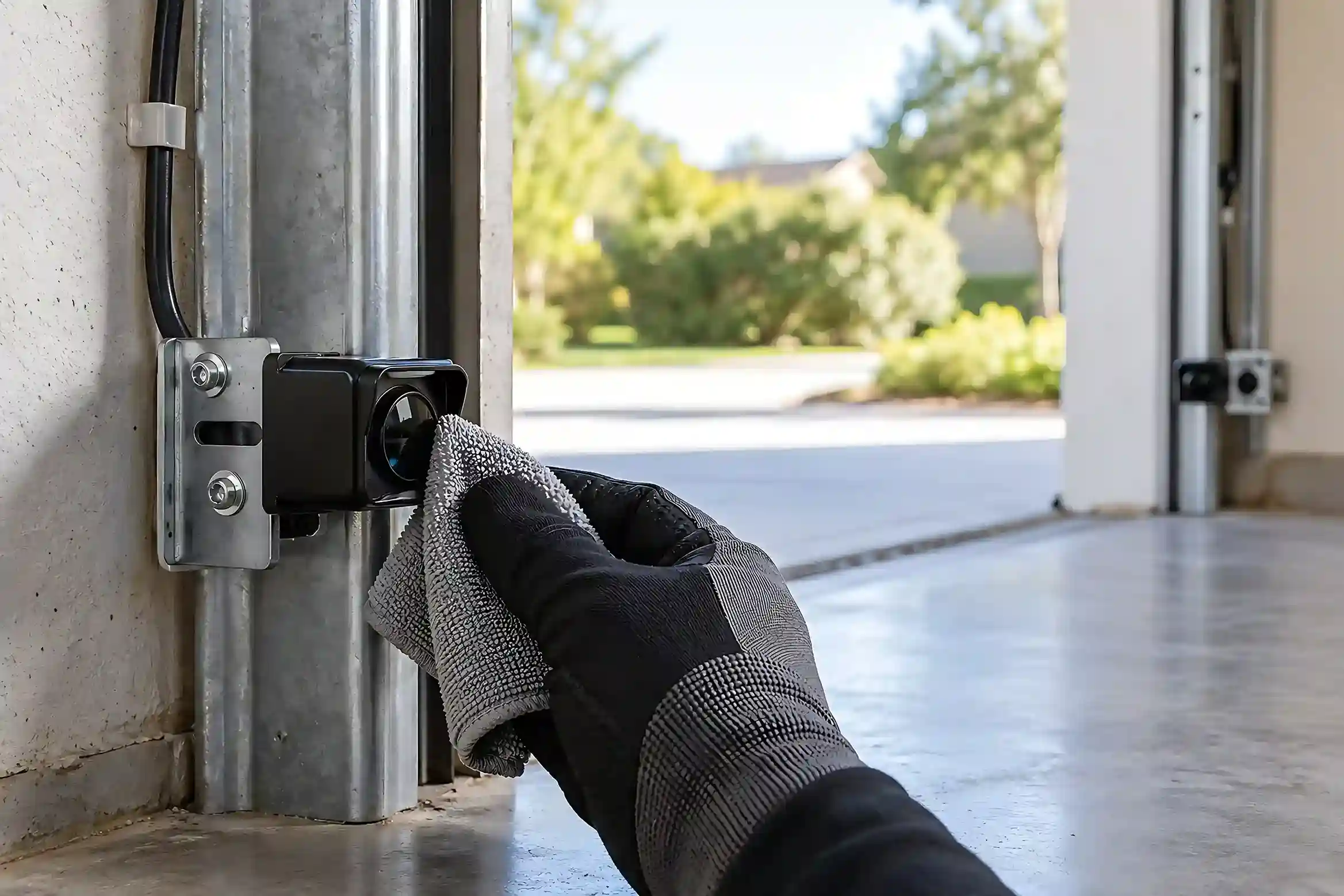
You press the button, the door starts down, then stops halfway and slides back up. Or it won’t move at all, and the lights on the sensors near the floor are blinking yellow or dark.
That’s your safety sensors talking. In our 30 years of servicing garage doors, most sensor problems are fixes you can complete in 15 minutes. Prefer to skip the troubleshooting? Our team handles this weekly through garage door tune-ups and repairs.
What Causes Garage Door Sensors to Stop Working?
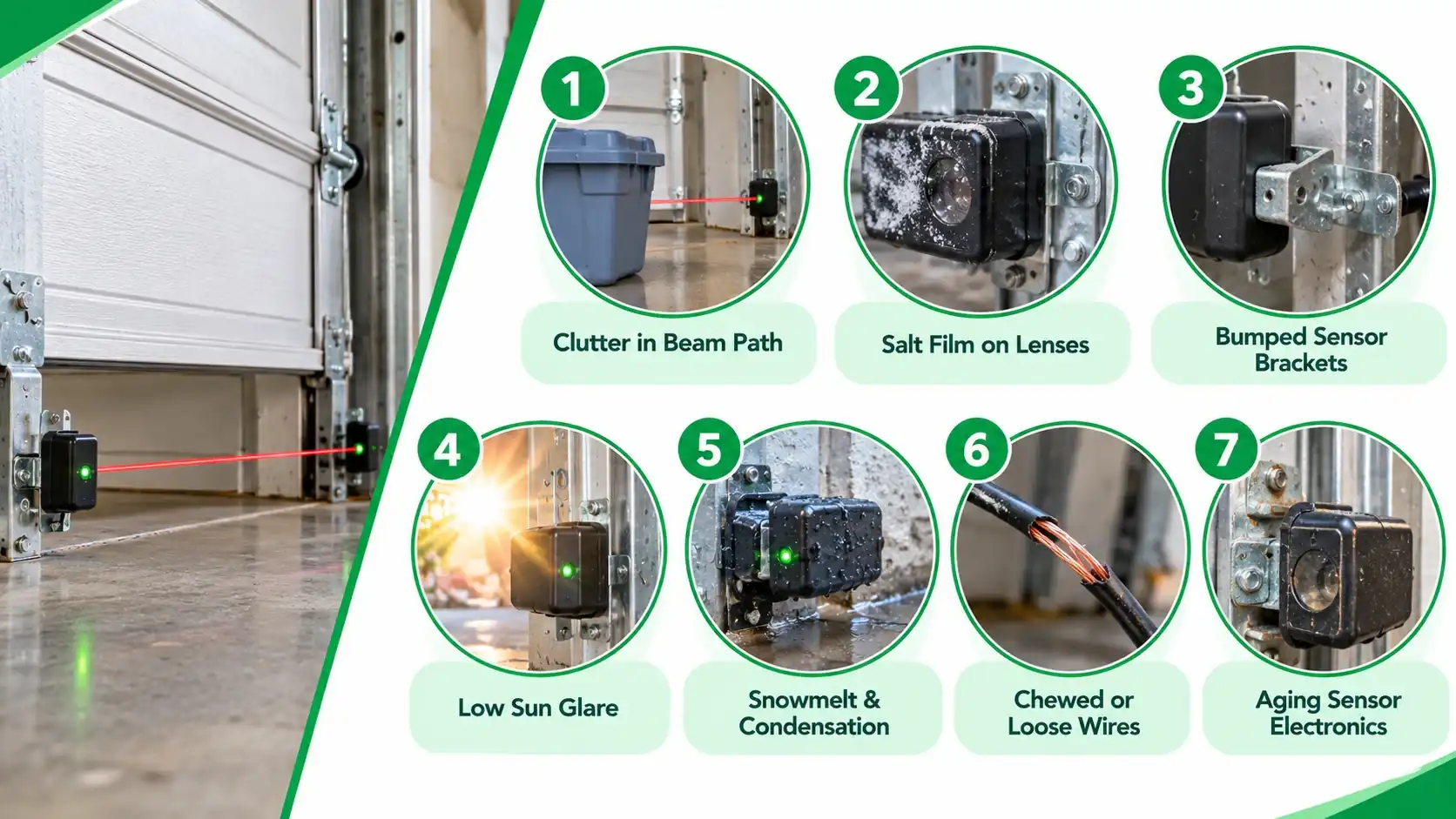
A sending eye shoots an invisible infrared beam to the receiving eye, 4 to 6 inches above the floor. If it breaks, weakens, or loses power, the opener assumes someone is in the way and reverses the door. The usual causes in an Ohio garage:
Clutter in Beam Path
The beam is thin and sits close to the floor, so bins, bikes, and shovels are not the only culprits. A single cobweb strand, a leaf, or a ridge of packed snow can also cut the signal. Winter adds salt bags and sleds. Check the full line between the two eyes, not just the area near each sensor.
Salt Film on Lenses
Road salt, dust, and tire splash leave a thin film on the lens that you can barely see. It doesn’t block the beam completely but weakens it, so the indicator light looks dim or flickers instead of glowing steadily.
Bumped Sensor Brackets
A nudge from a car bumper, mower, or shovel can shift a bracket by a few degrees. On a 16-foot opening, that tiny angle sends the beam past the receiving eye. A steady light on one sensor with a blinking light on the other usually points to this.
Low Sun Glare
Strong sunlight hitting the receiving eye directly can drown out the infrared signal. This happens at sunrise and sunset, especially in late fall and winter when the sun sits low. If the sensors work at noon but fail on certain evenings, sunlight is the likely cause.
Snowmelt and Condensation
Melting snow dripping off your car, high humidity, or a hosed-down floor can fog the lens or corrode the wire contacts inside the housing. Sensors that act up only after wet weather point to moisture.
Chewed or Loose Wires
Sensor wires are thin, low-voltage lines run along the wall and ceiling. Mice chew them in cold months, and old staples or loose terminal screws can cut power. Wiggle the wire gently. If the light flickers, that’s your weak spot.
Aging Sensor Electronics
Most sensors last 5 to 10 years before the internal electronics weaken. If cleaning, alignment, and wiring checks don’t help, replace both sensors as a matched pair.
What Does It Mean When Both Lights on My Garage Door Sensors Are Out?
Dark lights usually mean no power is reaching the sensors. Check in this order:
- The opener’s plug – Make sure it’s fully seated in the ceiling outlet.
- The outlet and breaker – Test the outlet with a lamp, then check the GFCI and breaker panel.
- The sensor wires – Follow each wire to the opener, looking for pinched staples, cuts, or loose terminal screws.
- The control board – If power and wires check out, the sensors or board may have failed.
How Can I Fix My Garage Door Sensors at Home?
A yellow, blinking, or weak light means the sensors can’t “see” each other. Work through these in order:
- Clear the path: Remove anything between the sensors, including cobwebs, leaves, or snow, and check behind the tracks.
- Clean both lenses: Wipe each with a soft, dry microfiber cloth and check inside the hood for webs. Skip harsh sprays.
- Shield them from sunlight: If the problem follows the time of day, shade the lens with your hand to test, then add a cardboard tube or sun shield.
- Realign the sensors: Loosen the wing nut on the receiving sensor (green light), aim it at the other until the light turns solid, then tighten. If it still blinks, adjust the sending sensor.
- Tighten the brackets: Keep both sensors at the same height, facing each other, 4 to 6 inches above the floor, per federal safety guidance.
Unsure it’s the sensors? Other everyday garage door troubles can mimic a sensor fault.
Is There a Way to Reset My Garage Door Sensors?
Sensors have no reset button. What people mean is power-cycling the opener, which clears minor control-board glitches: unplug it for 30 seconds, plug it back in, and watch for steady lights. It won’t realign or clean anything, so if the lights still blink or stay dark, revisit the fixes above. On a hardwired opener, switch the breaker off instead.
Can I Disable or Override My Garage Door Sensors?
A garage door can technically run without working sensors, but it shouldn’t. Openers sold in the US since 1993 must have them, because they stop the door from closing on a child, a pet, or a car. If the door is stuck open, press and hold the wall button until it reaches the floor. It moves only while you hold it, so watch it the whole way. Use this as a one-night workaround.
Never wire the terminals together, tape the eyes, remove the sensors, or aim them higher. If they keep misbehaving, repair or replace them.
How Long Does a Garage Door Sensor Typically Last?
Most last 5 to 10 years. Replace them if lights flicker after cleaning and alignment, the housing is cracked or full of moisture, or the wire insulation is breaking down. If the opener itself is suspect, it helps to know what repairing a faulty garage opener involves.
When Should You Call a Professional?
DIY covers cleaning, clearing, and realigning. Call a technician if:
- The lights still blink or stay dark after the fixes above.
- You find damaged wiring inside a wall or ceiling.
- The door fails the beam-block or 2×4 test.
- You smell burning, or the opener light keeps flashing with no clear cause.
A technician can meter-test the wire run, replace sensors, and verify the safety reverse, the step most homeowners can’t check alone. The U.S. Consumer Product Safety Commission’s federal garage door safety guidance also says to stop using an opener that fails the reverse test.
Frequently Asked Questions
Q1. Which garage door sensor is the sending eye?
On LiftMaster and Chamberlain, the amber light is the sending eye and the green light is the receiver. Adjust the green one first.
Q2. Can I replace just one garage door sensor?
Yes, but use the same brand and series. Mixed brands may not communicate, so a matched pair is safer.
Q3. How often should I check my sensors?
The CPSC advises inspecting your door and opener every 30 days. A quick lens wipe and beam check catches most problems early.
Q4. Do garage door sensors have batteries?
No. Standard safety sensors get low-voltage power through the wires from the opener, so they don’t need batteries. If both lights are dark, check power and wiring instead.
Q5. How many sensors does a garage door need?
One pair: a sending eye on one side of the door and a receiving eye on the other. This applies to a single-wide door too. A two-car garage with two separate doors has two openers, so each door gets its own pair.
Final Thoughts
Sensor trouble almost always comes down to something in the way, dirty lenses, or a bumped bracket. Work through the fixes in order, check power if both lights are dark, and never leave the sensors disabled.
Still stuck? Request your free estimate today. We offer 24/7 service, and a technician can get your door closing safely again quickly. We’ve cared for Central Ohio garages since 1996. For everything from sensors to full door replacements, explore our complete garage door services anytime.