
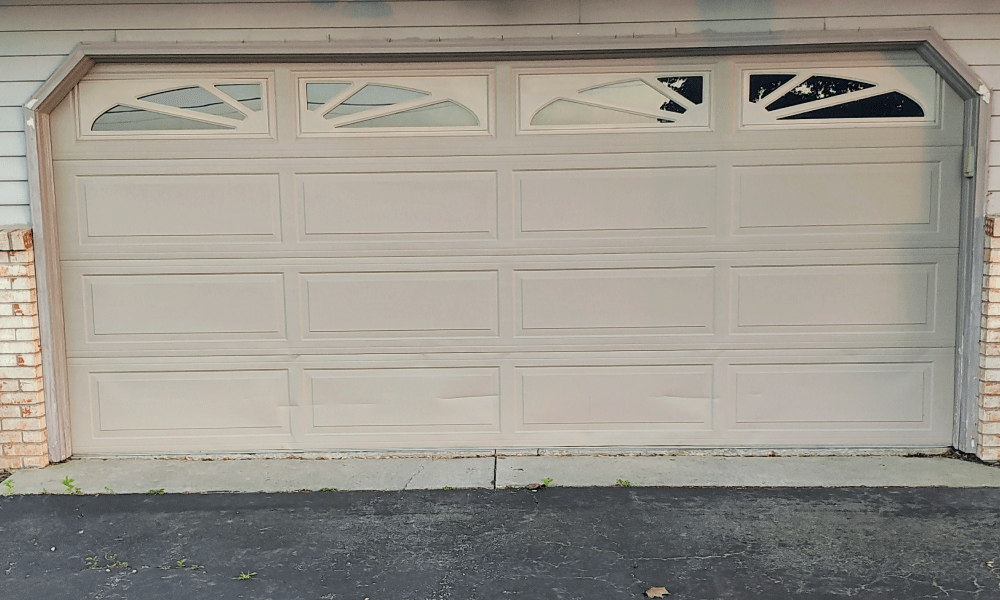
Your garage door takes up more visual real estate on your home’s front elevation than most people realize, sometimes 30% or more. So when homeowners in central Ohio start asking about carriage-style doors, it’s rarely just about the door itself. It’s about the entire feel of the home. Here’s the honest answer most posts skip: a carriage-style door does not automatically open differently than your current door. And that distinction could save you from a costly misunderstanding before you buy.
A carriage-style garage door is a modern overhead door designed to look like the old swing-out barn and carriage house doors of the 1700s and 1800s. It uses decorative hardware crossbuck patterns, strap hinges, center handles to create a historic appearance, while still operating on standard overhead tracks just like a traditional panel door. The core difference between carriage-style and traditional? Visual character, not operating mechanics.
What Actually Makes a Garage Door “Carriage Style”?
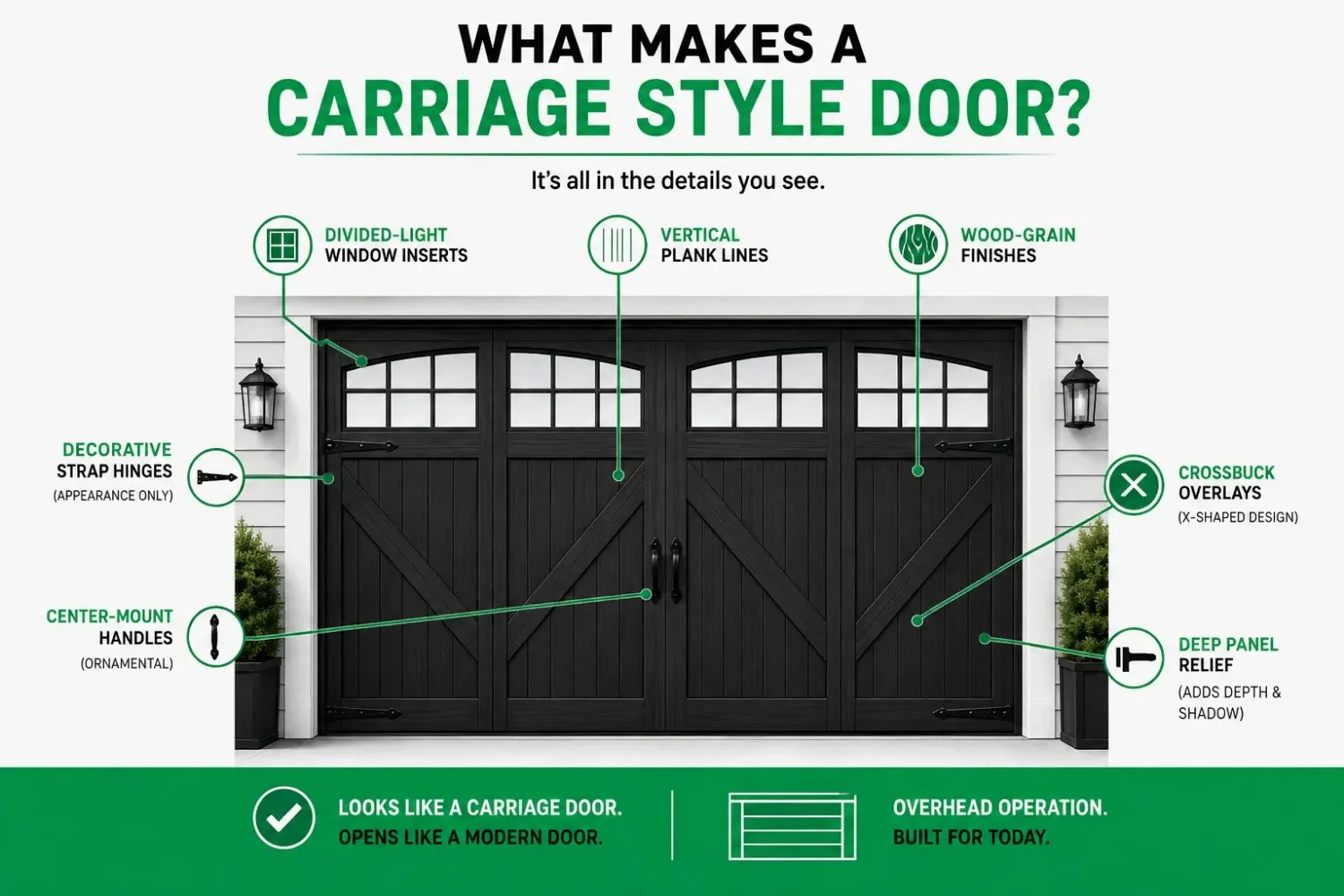
The carriage look isn’t about how the door moves. It’s about what you see when it’s closed.
Carriage house garage doors typically feature:
- Crossbuck (X-shaped) overlays running diagonally across each section
- Vertical plank-style lines that mimic old wood planking
- Decorative strap hinges these don’t pivot; they’re mounted flat for appearance
- Center-mount handles that look functional but are ornamental on most overhead models
- Divided-light or arched window inserts across the top row
- Wood-grain finishes that mimic natural timber without the upkeep
- Deep panel relief that creates visible shadow lines and texture
That layered, dimensional quality is what separates a carriage house door from a flat-panel traditional door. Stand at the end of a driveway and the difference reads immediately. One clarification worth making: when you see large decorative hinges on a modern overhead door, do not assume the door swings outward. In the vast majority of residential installs today, those hinges are surface-mounted and purely visual. The door travels up on tracks the same way a standard sectional door does.
How Do Carriage Garage Doors Open?
Most modern carriage-style doors open exactly like any other sectional overhead door the panels hinge together, roll up the track, and rest horizontally above the opening. Authentic swing-out carriage doors do exist, and some homeowners specifically want them for restoration or barn-aesthetic projects. But they require clear driveway space in front of the garage (often 8–10 feet), which makes them impractical for most residential driveways. They also cannot be automated the same way as a standard overhead opener.
If you’re comparing overhead carriage-style doors to traditional sectional doors strictly on operation, they work the same way. The difference is entirely on the exterior face. Not sure whether your existing opener and hardware can support a new door design? Our team handles garage door maintenance and repairs near you across central Ohio and part of that work is evaluating whether an existing system is ready for a new door, or whether the springs, tracks, and opener need attention first.
Carriage Style vs. Traditional Garage Door: The Real Differences
Here’s where most comparison guides get shallow they list features without explaining why each choice matters for your specific home.
| Feature | Carriage-Style Door | Traditional Garage Door |
| Panel design | Crossbuck, vertical, or detailed overlays | Raised, recessed, or flat rectangular panels |
| Hardware | Decorative hinges, handles, and straps | Minimal functional only |
| Windows | Divided-light, arched, or decorative | Simple rectangular layouts |
| Visual depth | High deep shadow lines and texture | Lower cleaner, flatter appearance |
| Operation | Overhead (same as traditional) | Overhead |
| Best fit | Homes with architectural character | Homes where clean lines are preferred |
The common misconception is that choosing carriage style means choosing a more complex system to maintain. In reality, a steel carriage-style sectional door and a steel traditional sectional door have near-identical mechanical components. The maintenance difference is minimal. What does differ: surface hardware. Decorative overlays and applied molding on carriage doors can collect debris or show wear in high-sun or high-moisture environments. That’s worth knowing before you choose.
Do Carriage-Style Doors Actually Boost Curb Appeal?
The mistake homeowners make is choosing a carriage door because it looked impressive in a showroom photo, then installing it on a home with very different architecture. A heavily ornamented crossbuck door with iron hardware can look forced on a contemporary flat-roof home. It can look outstanding on a Craftsman bungalow.
Curb appeal comes from visual coherence, not from adding decoration. A carriage house style garage door earns its place when:
- The panel lines echo details already present in the home (board-and-batten siding, horizontal shiplap, cedar shingles)
- The window layout is proportional to existing windows on the facade
- Hardware finish (black, oil-rubbed bronze, brushed nickel) is consistent with entry hardware and light fixtures
- Door color reinforces not fights the trim and siding palette
When those elements align, a carriage-style door can transform the front of a home. When they don’t, it reads as a mismatch regardless of how beautiful the door is on its own.
We’ve worked with enough homeowners since 1996 to say with confidence: the homes where a new door made the biggest difference weren’t the ones with the most decorative hardware. They were the ones where someone took time to look at the whole front elevation before choosing. To explore the full range of door styles available for your home, take a look at our complete guide to types of garage doors.
What Materials Are Available for Carriage-Style Doors?
Steel carriage-style doors are the most practical choice for most homeowners. They hold a finish well, resist dents better than fiberglass, and can be manufactured with convincing wood-grain embossing. Insulated steel models also give you real thermal performance useful if your garage doubles as a workspace.
Wood carriage doors deliver authentic texture and aging character that no overlay can fully replicate. They’re the right choice when natural materials are essential to the home’s character. The trade-off is maintenance: wood needs periodic refinishing and is more sensitive to moisture cycling. Composite and wood-look options sit in between. They offer more dimensional appearance than flat steel and require less upkeep than real wood, though they don’t age with the same character over time.
One overlooked factor: door weight. Decorative overlays, wood cladding, and added hardware all add mass. A door significantly heavier than what the existing spring system is rated for will strain the opener and wear springs prematurely. This is a practical reason to involve a professional in the selection process, not just the installation.
Frequently Asked Questions
Q.1 Are carriage-style garage doors more expensive than traditional doors?
Generally yes, due to the added surface detail, hardware, and finish options. Steel carriage-style doors represent the most accessible price point. Real wood carriage doors sit at a higher investment level. That said, pricing varies significantly by size, insulation rating, and manufacturer and we don’t quote prices without seeing the opening and understanding your specific needs.
Q.2 What are old-style garage doors called?
They’re commonly called carriage house doors, swing-out carriage doors, or hinged carriage doors. The term describes both the historic originals and modern reproductions that recreate the look using overhead hardware.
Q.3 How do carriage garage doors open?
Modern carriage-style doors open vertically on overhead tracks the same mechanism as standard sectional doors. Only true swing-out carriage doors open outward, and those require clear driveway space and specific hardware.
Q.4 Can a carriage-style door work on a contemporary home?
Yes, with the right design choices. Simplified crossbuck details, restrained hardware, and a monochromatic finish can give a carriage-style door a clean, updated look that doesn’t compete with modern architecture.
Q.5 What is the most popular color for a carriage-style garage door?
Black and dark charcoal finishes have gained significant traction in recent years, particularly paired with white or light gray siding. Classic white and warm wood-tone finishes remain strong choices for farmhouse and Craftsman homes.
Q.6 How long do carriage-style garage doors last?
Steel carriage-style doors typically last 15–30 years with proper maintenance. Wood doors depend heavily on how well they’re finished and refinished over time. The mechanical components springs, tracks, opener are separate from the door itself and have their own maintenance schedules.
Is a Carriage-Style Door Right for Your Home?
The right door isn’t the one that looks most impressive in isolation. It’s the one that makes your home look like it was designed with intention from the roofline down to the driveway. If you’re leaning toward a carriage house style garage door, start by looking at your facade as a whole: the entry door, windows, trim details, siding texture, and hardware finishes already in place. A carriage door that echoes those details will look deliberate. One that doesn’t will look like an addition.
The Door Guys has been helping homeowners across central Ohio make those decisions since 1996. Whether you’re replacing a worn-out door, upgrading for curb appeal, or starting from scratch on a new build, we evaluate the full picture not just the door catalog. For a free estimate or to talk through your options, contact The Door Guys.