

Your garage door opens and closes every day without a problem. But the tracks hug the ceiling too low, the opener rail runs right through the middle of your workspace, and now you’re trying to figure out if a car lift, an oversized truck, or a proper storage system will ever actually fit.
The question most homeowners type into Google at that point is some version of: “Can I just change the tracks and keep the door I have?”
In most cases, yes, but a high-lift garage door conversion is not a track swap. It’s a full mechanical reconfiguration of your door system, and how well it works depends on things most online guides don’t fully explain. This post covers the honest version: what changes, what it costs to think about, who should handle it, and how to decide whether conversion or full replacement makes more sense for your specific garage.
What Actually Changes in a High-Lift Conversion?
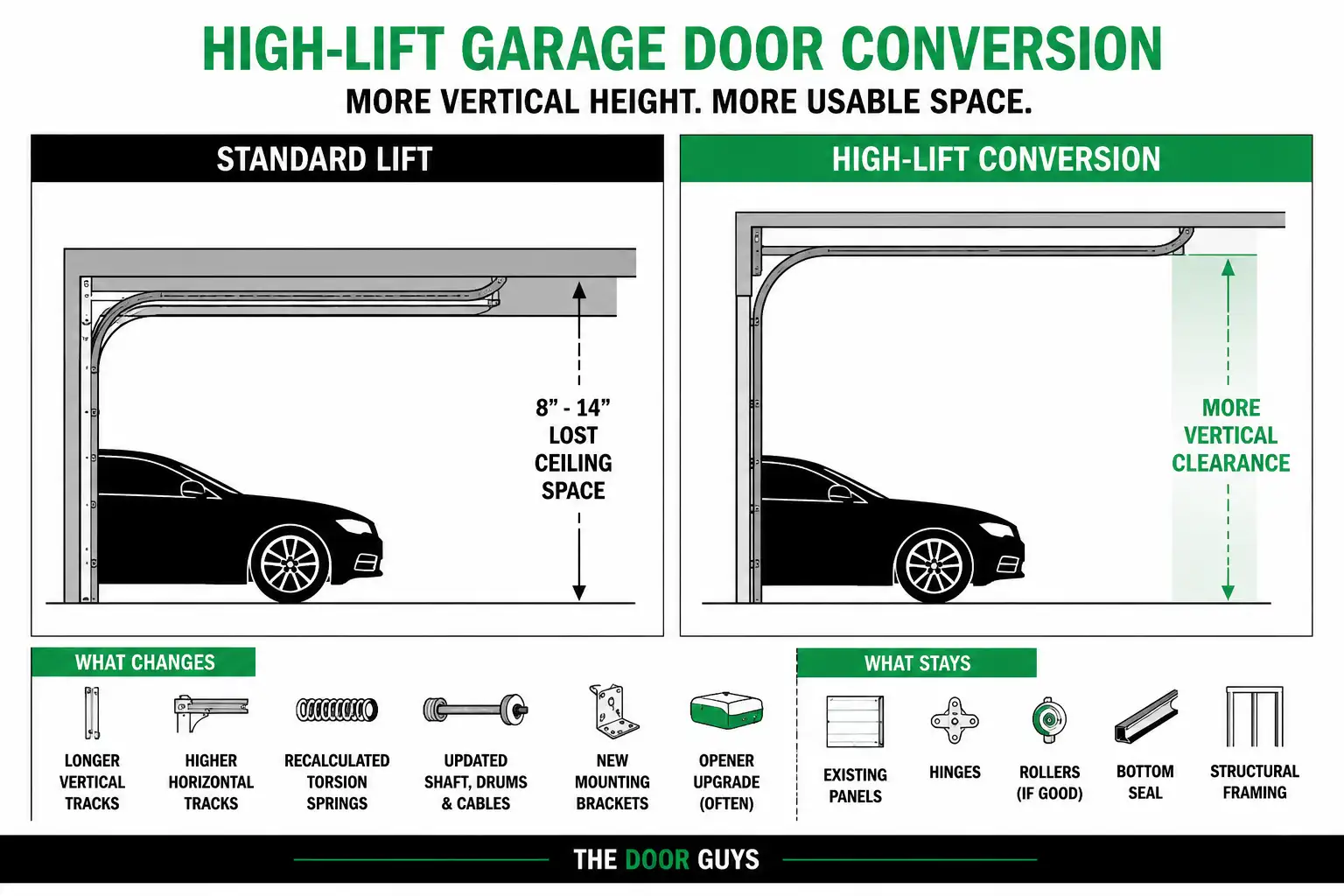
A conventional sectional door travels straight up through the jamb tracks, then transitions quickly onto horizontal tracks that run toward the back of the garage near the ceiling. That curve happens close to the top of the opening, which means the door panels end up eating 8 to 14 inches of your ceiling almost immediately.
A high-lift arrangement delays that curve. The door keeps traveling vertically for longer, sometimes several feet, before turning toward the ceiling. The result: the panels stack higher on the wall, the horizontal tracks end up farther back, and the space directly above and behind the opening stays clear.
What physically changes during a proper conversion:
- Vertical track sections longer to support the extended vertical travel
- Horizontal track sections repositioned higher and often farther back
- Torsion springs recalculated for the new travel distance and door weight
- Torsion shaft often longer to match the new drum and cable geometry
- Cables and drums re-specified to match the new lift height
- Mounting brackets and top fixtures updated for the new track positions
- Opener frequently replaced, especially if it’s a ceiling-mounted trolley style
What typically stays the same: your door panels, hinges, rollers (if in good shape), bottom seal, and the structural framing around the opening.
This matters because if your panels are still solid, you may not need to touch them at all. Keeping good sections is one of the main reasons homeowners convert rather than replace.
Can My Existing Sectional Garage Door Be Converted?
Many can, but the door condition is only one factor on a longer list.
When a technician evaluates a conversion at The Door Guys, we’re looking at the whole picture, not just ceiling height:
The door itself:
- Are the panels straight, undamaged, and properly reinforced?
- Are the rollers, hinges, and cables still performing well?
- Is the door weight within a range the new spring system can handle?
The space inside the garage:
- What’s the actual floor-to-ceiling height in the lift zone?
- How much headroom exists above the opening (from the top of the door opening to the ceiling)?
- Is there enough sideroom to mount the new hardware?
- How far back does the door need to travel (backroom)?
Obstructions:
- HVAC equipment, lights, shelving, exposed beams, low joists all of these affect the track path.
The opener:
- Is it ceiling-mounted? Wall-mounted? Is it compatible with the new travel range?
A door that checks all those boxes is a strong conversion candidate. A door with damaged panels, a compromised spring system, or inadequate headroom for even a standard lift may be better replaced than reconfigured.
How Much Clearance Do You Actually Need?
This is where most guides leave homeowners with a number that sounds useful but isn’t.
“You need at least 12 feet of ceiling height” is a common answer, and it tells you almost nothing on its own.
The real question is: how high does your door need to travel to stay out of the way of what you’re putting in the garage?
Here’s how to think through the math:
If you’re installing a two-post car lift, a typical full-size model has an overhead bar that sits around 11 to 12.5 feet at full rise. Add the vehicle roof height, plus a few inches of working clearance, and you can quickly see that “I have a 10-foot ceiling” does not automatically mean a conversion will work or that it won’t.
If you’re parking a lifted truck or tall van, the measurement that matters is the vehicle’s actual height relative to where the open door panels will be sitting.
If your goal is overhead storage, the equation is simpler: how high does the shelf or rack need to go, and where will the door panels be when the door is fully open?
The four measurements that drive every conversion decision:
- Floor-to-ceiling height (measured in the area where the door and lift will interact)
- Height of the garage door opening itself
- Height of the door in its fully open position
- Lowest obstruction in the target zone
These numbers need to come from a physical site measurement, not a rough estimate based on ceiling height alone. We’ve seen garages with 12-foot ceilings that couldn’t accommodate a certain lift because of low steel beams, and 10-foot garages that worked perfectly with the right conversion configuration.
What Does a High-Lift Conversion Actually Involve?
Here’s the honest step-by-step not a DIY guide, but what a professional conversion looks like from start to finish:
- Full inspection of the existing door system
Springs, cables, drums, rollers, hinges, panels, and balance are all evaluated before anything else. If the existing system has deferred maintenance issues, those get addressed before the conversion, not after. - Precise garage measurements
Ceiling height, headroom, sideroom, backroom, opening dimensions, and obstruction mapping. This is what determines whether the conversion is viable and what configuration will work. - Determining the required lift height
This is project-specific. A homeowner adding a two-post lift needs a different configuration than someone building overhead storage. The conversion is designed around the actual goal. - Designing the new track path
The high-lift track geometry has to match the door dimensions, the garage dimensions, and the purpose of the project. There’s no universal kit that fits every garage. - Recalculating the counterbalance system
This step is the one most DIY guides gloss over, and it’s the most consequential. When you change the travel path of a sectional door, the spring and cable system must be recalculated from scratch. Using the old springs on a new configuration is one of the most common sources of post-conversion problems: doors that slam shut, won’t stay open, or put unsafe stress on the hardware. - Evaluating or replacing the opener
A ceiling-mounted trolley opener runs on a rail that spans the ceiling, the exact space a high-lift conversion is trying to free up. In many cases, a wall-mounted jackshaft opener is the right solution. It mounts beside the door on the wall, drives the torsion shaft directly, and doesn’t occupy the overhead zone at all. Some high-lift projects can retain the existing opener; many cannot. This needs to be confirmed based on the new door geometry, not assumed. - Final balance testing and full-cycle verification
A properly converted door should hold position at any point in its travel, move smoothly without binding, and stop correctly on the opener’s sensors. Balance testing isn’t optional; it’s the difference between a door that operates safely for years and one that creates a hazard.
Can I Keep My Current Opener?
Possibly, but it needs to be evaluated after the new geometry is confirmed, not before.
The compatibility question isn’t just about the opener brand or model. It’s about whether the opener’s rail, travel limits, and mounting position are compatible with the door’s new movement path.
A wall-mounted jackshaft operator is often a better fit for high-lift configurations. It removes the ceiling rail entirely, mounts to the wall alongside the door, and leaves the overhead zone available for whatever you’re converting for. Most current wall-mount operators include smart home connectivity, battery backup, and safety features comparable to top-of-the-line trolley units.
If your existing opener is relatively new and the geometry works, keeping it may be practical. If it’s older, or if the rail creates a clearance conflict, replacing it as part of the conversion is usually the more cost-effective long-term choice.
What Most High-Lift Guides Don’t Cover
Having done this work in Central Ohio since 1996, we’ve seen where things go sideways, and most of it doesn’t show up in the articles competitors publish.
Opener interference with the lift zone
Even wall-mount operators have a physical footprint. If you’re installing a two-post lift, the column positions and the operator location need to be planned together before anything is ordered or installed. We’ve corrected conversions where the operator was mounted right where a lift column had to go.
Spring cycle life after conversion
New springs installed as part of a high-lift conversion should be matched to the new travel distance and door weight. Springs that are correctly rated will reach their full cycle life. Springs that are mismatched either over- or under-wound wear out earlier and can fail without warning. Ask specifically about spring specifications when getting a conversion quote.
Warranty implications
Modifying your door’s track system and spring configuration typically voids the original manufacturer’s warranty on springs and opener components. Panels and panel warranties are usually unaffected by a track change. Knowing this before the project helps you make a fully informed decision, especially if the door is still under any original coverage.
Unusual framing and structural considerations
Older homes sometimes have single-member headers, non-standard framing, or exposed beams that affect where hardware can be mounted and how much weight the structure can support. We check header conditions and sideroom framing before mounting new hardware.
Understanding types of garage doors and how they interact with different track configurations also matters; not every panel style is equally suited to high-lift travel, and some specialty doors have hardware that doesn’t translate cleanly to a conversion.
Is a High-Lift Conversion Worth It?
The answer depends on what you’re trying to accomplish and the condition of your existing door.
It tends to make strong sense when:
- You’re installing a vehicle lift and the overhead bar clearance is the limiting factor
- You’re working on tall trucks, vans, or SUVs that don’t fit under the open door
- You’re adding overhead storage or a workshop setup and need ceiling access
- The existing door panels are in good condition, and the door size still meets your needs
- The main problem is the lifting configuration, not the door itself
It may not make sense when:
- The door panels are warped, damaged, or poorly insulated
- The existing spring and cable system is near the end of its service life
- The overhead clearance gain won’t actually be enough for your project
- A full replacement with a purpose-built high-lift system would cost similarly and provide a longer service life
The most practical question isn’t “conversion or replacement.” It’s which option gives you the specific clearance you need, from a system that will operate reliably for years, without replacing components that still have good life in them.
Understanding sectional garage door construction can also help you evaluate whether your panels are worth keeping; some older sectional doors are genuinely solid; others are a liability waiting to happen.
Not a Weekend DIY Project
High-tension torsion springs store hundreds of pounds of force. A spring failure during installation isn’t a minor inconvenience; it’s a serious safety event.
Beyond the springs, getting the track geometry, cable lengths, drum profiles, and spring winding specifications right requires experience with how garage door systems behave in practice, not just how they’re described on paper. A conversion that’s mechanically off, even slightly, creates ongoing balance problems and premature wear.
FAQs
Q.1 How much does it cost to convert a garage door to high lift?
A high-lift conversion involves new tracks, springs, drums, cables, brackets, and often a new opener, so the total varies based on door size, required lift height, opener compatibility, and labor. We don’t publish flat rates because the right quote comes from a site-specific assessment, not a form. What we can tell you is that a conversion of a door in good condition is typically less expensive than a full replacement, and it offers better value when the existing panels have meaningful life left in them. For a general frame of reference on door-related costs, our garage door installation cost guide covers the variables that affect pricing.
Q.2 How much does it cost to increase the height of a garage door?
Increasing the actual opening height (making the rough opening taller) is a structural project involving framing and header work, different from a high-lift conversion, which doesn’t change the opening size but changes how high the door travels when open. Most homeowners asking this question actually want the clearance a high-lift track system provides, not a taller opening.
Q.3 How do you make a garage door lift higher?
You change the track path, not the opener’s travel limits. Adjusting the opener only controls where the door stops; it doesn’t change the physical geometry of how the door moves. A proper high-lift conversion redesigns the track path, recalculates the springs and cables, and reconfigures or replaces the opener to match. No shortcut achieves the same result.
Q.4 Is a high-lift garage door worth it?
For the right situation car lift installation, taller vehicles, serious overhead storage yes, clearly. The conversion adds meaningful, lasting clearance and often allows you to keep a door you would otherwise have to replace. For a garage where the existing door and ceiling height are already adequate, it adds cost without adding benefit. The worth depends entirely on whether you have a specific clearance problem the conversion actually solves.
Q.5 Can I use my existing garage door opener after a high-lift conversion?
Sometimes, but it requires evaluation after the new geometry is confirmed. Ceiling-mounted trolley openers often conflict with the overhead zone a high-lift conversion is designed to free up. A wall-mounted jackshaft operator is frequently the better fit.
Q.6 Do I need a permit to change garage door tracks in Ohio?
Track and spring changes on an existing door opening typically don’t require a permit in most jurisdictions, but requirements vary by municipality. Marion, Dublin, Columbus, and Delaware all have their own building department rules. Confirm with your local building department before assuming no permit is needed, especially if any structural modifications are involved.
Get a Real Assessment, Not a Guess
The Door Guys has been handling garage door systems across Central Ohio since 1996. We’ve done high-lift conversions for homeowners installing vehicle lifts, building shop spaces, and trying to get the most out of garages they’ve had for decades.
Our process starts with measurement. We look at your actual space, your actual door, and what you’re actually trying to accomplish, then tell you whether conversion makes sense, what it will take, and whether a different approach would serve you better. If you’re comparing your options further, our garage door repair and service overview covers the full range of what we do.