
You enter your PIN, press the button, and nothing happens. A garage door keypad not working is frustrating, but the cause is often simple, like a weak battery, a worn button, or lost pairing with the opener.
You can usually find the problem in a few minutes without replacing anything. If basic checks fail, our garage door maintenance and repair services can tell you whether the keypad, its connection, or the opener is at fault.
Why Is My Garage Door Keypad Not Working?
A keypad usually stops working because of a dead battery, worn buttons, a wrong or expired PIN, lost pairing, moisture, or signal interference. Sometimes the keypad is fine but can’t communicate with the opener.
|
Symptom |
Likely cause |
Check first |
|
No lights or response |
Dead battery or poor contact |
Battery and contacts |
|
Lights up, door won’t move |
Wrong PIN, pairing, or lock setting |
PIN and pairing |
|
Only some numbers work |
Worn buttons |
Each button |
|
Works occasionally |
Weak battery or moisture |
Battery and weather |
|
Closes door but won’t open it |
Expired temporary PIN |
PIN type |
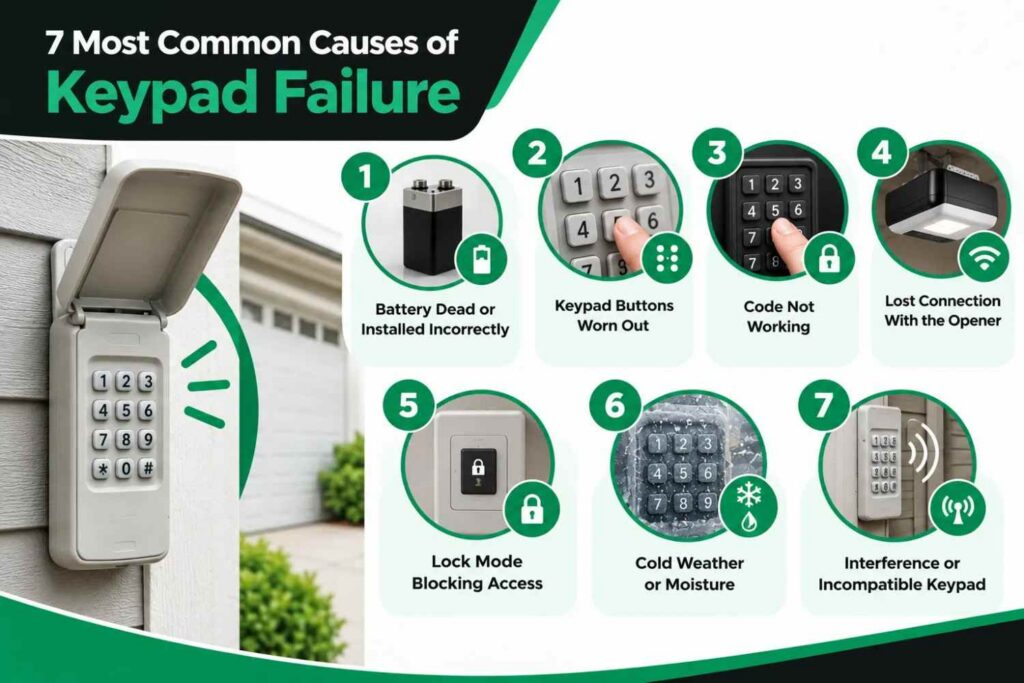
What Are the 7 Most Common Causes of Keypad Failure?
1. Is the Battery Dead or Installed Incorrectly?
A weak battery is the most common cause. It powers both the backlight and the signal to the opener, so a failing one makes the keypad unreliable first. Chamberlain says most of its keypads use a 9-volt battery and some older ones use a 12-volt, but other brands differ. Check your manual for the exact type.
2. Are the Keypad Buttons Worn Out?
Years of use can leave buttons stiff or dead. If your usual PIN fails, program a different PIN without the suspect number. If the new one works, a button is probably failing.
3. Why Is My Garage Door Code Not Working?
The PIN may have been changed, mistyped, or set as a temporary code. Chamberlain notes that an expired temporary PIN can still close the door but can no longer open it. Confirm the PIN, wait out any lockout, and reprogram if needed.
4. Has the Keypad Lost Its Connection With the Opener?
If the keypad lights up but the door doesn’t move, pairing may be lost. First, test the wall button or a remote. Don’t hold the opener’s Learn button without checking your manual. On many models, holding it too long erases every stored remote and keypad.
5. Is Lock Mode Blocking the Keypad?
Some openers have a Lock or Vacation feature that limits wireless access, so the keypad fails while the wall control still works. Check the wall control and your manual, because behavior varies by model.
6. Can Cold Weather or Moisture Stop a Keypad?
Yes. Cold weakens batteries, and water can enter a cracked housing. Look for condensation, corrosion, and cracks. If you find heavy corrosion inside, replace the keypad rather than attempt electrical repairs.
7. Is Interference or an Incompatible Keypad the Problem?
Chamberlain notes the mounting surface can interfere with the signal. Try rubber grommets or a small wooden backing. Compatibility matters too, so note your opener’s brand and model before buying a replacement.
Why Is My Keypad Not Working After Changing the Battery?
A new battery restores power but can’t repair damaged contacts, worn buttons, or lost pairing. Check that the battery type and polarity are right. Inspect the contacts for white or green corrosion and bent terminals. Many keypads keep their programming during a battery change, but not all do. If the keypad still doesn’t respond, it may need reprogramming per your manual.
How Do You Fix a Keypad That Isn’t Responding?
- Check for lights, No light usually means a battery problem.
- Replace the battery with the correct type, with the positive and negative terminals oriented correctly.
- Test every button to find worn contacts.
- Confirm the PIN and check whether it was temporary.
- Test another control, If a remote also fails, read our guide on garage door remote repairs.
- Check lock mode and pairing using your manufacturer’s instructions.
- Inspect for damage to the housing, cover, and battery compartment.
If the door ignores every control, the problem is wider than the keypad. See how to fix a broken garage door opener. Keep children and pets clear while testing, and never bypass safety sensors.
When Does a Garage Door Keypad Need Replacing?
Replace it if the housing is cracked, moisture has damaged the electronics, or a button fails and troubleshooting doesn’t help. Don’t replace it for a dead battery, a wrong PIN, or lost pairing. Make sure the opener works normally first, because a new keypad won’t fix a faulty receiver.
When Should You Call a Professional?
Call if the keypad keeps failing after a battery change, shows corrosion, won’t pair, or if several controls stop working together.
Frequently Asked Questions
Q.1 Can a Garage Door Keypad Go Bad?
Yes. Worn buttons, corrosion, moisture, and failed electronics can all end a keypad’s life.
Q.2 Why Does My Keypad Work Sometimes but Not Others?
Usual causes are a weak battery, loose contacts, moisture, or interference. Note when it fails to narrow it down.
Q.3 Can I Replace the Keypad Without Replacing the Opener?
Usually, yes, if the new keypad is compatible and programmed to your opener.
Q.4 How Much Does a Replacement Keypad Cost?
It depends on the brand, compatibility, and whether you need installation. Get a quote for an accurate total.
Still Stuck? Get Help
If your keypad keeps failing after these checks, our team can find the cause and recommend the right fix. Contact us to describe the problem and schedule assistance.
Start with the battery, PIN, buttons, and pairing, and you’ll usually know whether the keypad or something bigger is at fault. For reliable garage door solutions, visit The Door Guys.
Source:
Chamberlain Group, The Wall Control Panel Works but the Keyless Entry Does Not