
Look up at your garage ceiling. Rails, rollers, a motor, and a lot of metal sit right where you might want lights, a fan, or storage. That is usually the moment people start searching for a garage door without tracks.
A trackless garage door removes the horizontal rails that carry a door back into the garage. Instead of rolling along the ceiling, the door pivots on hardware mounted at the sides of the opening. Most homeowners picture a standard setup like standard sectional garage doors with the tracks simply deleted, but the real mechanism is quite different.
A pivot-style trackless garage door works by locking the door panels into one rigid piece. That piece swings up and out on side-mounted pivot hardware, while springs balance its weight so it moves smoothly, by hand or with a compatible opener. No ceiling tracks are needed, but the door needs clear space in front of the opening to swing.
It is a door built to open without the overhead rails found on conventional sectional doors. The term covers more than one design:
- Pivot systems: the door acts as one rigid unit and rotates on side hardware.
- Vertical-stacking systems: the sections lift and stack above the opening instead of travelling back along the ceiling.
Swinging barn-style doors and sliding doors are a different category. They are not true trackless overhead doors, so this guide focuses on pivot systems, which is what most people searching this topic mean.
How Does a Trackless Garage Door Work?
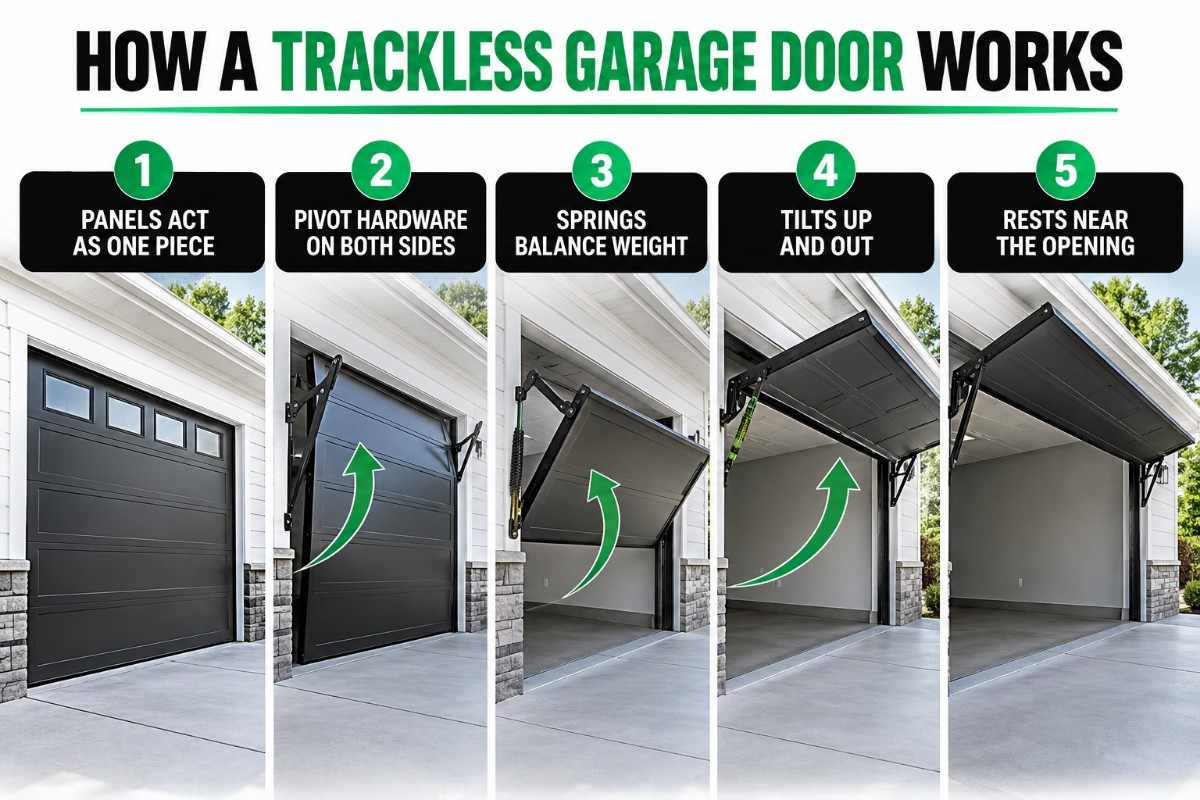
Here is the sequence, in plain terms:
- The panels become one piece. Rather than flexing at each hinge, the sections are fixed together as a single rigid door.
- Pivot arms or brackets carry the movement. Hardware on both sides of the opening creates a pivot point, and the door rotates around it.
- Springs do the heavy lifting. A garage door is heavy with or without tracks. Counterbalance components offset that weight so the door feels light and moves in a controlled way.
- The door tilts up and out. The bottom edge travels in an arc. Part of the door moves outside the opening and part moves inside, depending on the geometry.
- The door rests clear of the ceiling. When open, it sits near the opening instead of extending deep into the garage.
If you use an opener, it has to be designed for this motion. A standard overhead operator cannot simply be bolted on.
Are There Trackless Garage Doors?
Yes, but “trackless” is a category, not one product. Some systems are pivot kits designed to work with compatible door panels. Others are purpose-built doors engineered around a track-free movement from the start. Ask which type you are being quoted, because the hardware, clearance and operation differ.
Can I Buy a Garage Door Without the Track?
You can, in two ways:
- Convert: certain pivot hardware is designed to work with existing panels, provided they are in good shape, the right size, and not too heavy.
- Purpose-built: a new door made for a no-track design, where every component is matched.
Conversion is not as simple as unbolting the rails. A sectional door is engineered to bend through a track path. Using it as a rigid pivoting door changes the stress on every panel and hinge.
How Do I Open a Trackless Garage Door Without Power?
Because the door is spring-balanced, it can usually be moved by hand if the installation includes a manual release. You should not be lifting the full weight of the door. If it suddenly feels heavy, uneven,n or jerky, stop and don’t force it. That usually points to a spring or hardware problem, and spring work is not a DIY job.
How Is Trackless Different From a Regular Sectional Door?
Focusing only on tracks and ceiling space:
| Sectional door | Trackless pivot door | |
| Overhead rails | Yes | No |
| How it moves | Sections roll back along rails | One rigid unit pivots |
| Path | Up, then back | Up and out |
| Ceiling space | Rails occupy it | Mostly left open |
The trade-off is simple: you give up overhead rail space and take on swing space outside. If you are weighing other opening styles, our comparison of swinging vs. sliding garage doors shows how different movement paths affect a garage. And if your real issue is a low ceiling rather than the tracks themselves.
What Most Trackless Door Guides Skip
Homeowners researching this topic tend to run into the same gaps. Here are the questions worth asking before you commit:
How far does the door swing outward?
It depends on door size, pivot location, and hardware. Measure the space in front of your garage, including where your vehicles stop and where a walkway begins, before you order anything. A door that opens into a parked car is a design problem, not a repair problem.
How does it seal without tracks?
The door still needs perimeter and bottom seals to keep out air, water, dust, and pests. Because the door arcs rather than slides, seals must be matched to that motion so they don’t drag or leave gaps.
What happens to the ceiling once the door is open?
That is the main benefit. Lights, fans, storage racks, ductwork,k or a finished ceiling can stay where they are.
Will my current panels work?
Sometimes. Weight, thickness, reinforcement,nt and hinge type all matter. Panels that perform well on rails may not suit a pivot conversion.
What about noise and wear?
Fewer rollers means fewer rolling parts to rattle, but pivot hardware, bearings, springs, and seals still carry load and need periodic inspection. A trackless door is lower on clutter, not free of maintenance.
Who Should Consider a Trackless Garage Door?
It is worth a serious look if you:
- Have a low ceiling or ceiling-mounted equipment competing for space
- Use your garage as a workshop or finished room
- Want a cleaner, more open interior
- Have enough driveway clearance for the door’s swing
It is a poor fit if your driveway is short, cars regularly park close to the door, or your existing panels are heavy or damaged.
Frequently Asked Questions
Q.1 How much does a trackless garage door swing out?
There is no single number. The outward arc depends on the door’s size, the pivot location, and the hardware. The right approach is to have the exact clearance measured at your opening before ordering.
Q.2 Can a regular garage door be converted to trackless?
Some systems work with compatible sectional panels, but not every door qualifies. Panel condition, weight, size, hinges,s and counterbalance all need to be checked first.
Q.3 Does a trackless garage door still use springs?
Most do. Springs, cables, or similar counterbalance parts offset the door’s weight, which is why trackless does not mean springless.
Q.4 Can a trackless garage door use an automatic opener?
Yes, some can be motorized, but the opener must be designed for the door’s pivot movement and hardware. It is not interchangeable with a standard overhead opener.
Q.5 Is a trackless garage door maintenance-free?
No. Pivot points, bearings, springs, seals, and fasteners still need regular inspection and adjustment.
Q.6 What if I just need more headroom, not a different door?
Then a track change may solve it without a pivot system. High-lift tracks are designed for exactly this, and you can explore high-lift garage doors to see how they compare.
The Bottom Line
A trackless garage door works by changing how the door moves, not just by removing rails. Panels act as one unit, pivot hardware guides the arc, and springs carry the weight. The payoff is an open ceiling. The cost is swing clearance outside and a need to check compatibility carefully.
We have worked on garage doors since 1996, and the most common mistake we see is choosing hardware before measuring the space it needs. Our team at The Door Guys looks at the opening, the existing door, and your actual use of the garage first, then tells you honestly whether trackless high-lift, f,t, or standard is the better route. As garage door experts in Central Ohio, we also see how seasonal changes, driveway layouts, and older framing can affect which option works.