
Before spending money on a replacement, there’s a good chance your existing remote can be repaired. At The Door Guys, we’ve found that many “dead” remotes actually have problems with batteries, programming, signal interference, or the opener, not the remote itself.
Can a Garage Door Remote Be Repaired?
Yes, garage door remote repairs are often possible. If the problem is related to battery contacts, signal interference, lost programming, receiver communication issues, or internal electrical faults, repair may be possible. In some cases, a routine garage door tune-up can also identify underlying issues affecting remote performance. However, severe physical damage, water intrusion, or outdated electronics may require replacement.
Why Most Homeowners Misdiagnose Remote Problems
Since 1996, The Door Guys has diagnosed thousands of garage door remote issues across Central Ohio. One thing we’ve learned is that homeowners often replace perfectly functional remotes when the real problem lies elsewhere.
One of the biggest mistakes we see in Marion, Delaware, Mansfield, Dublin, and throughout Central Ohio is homeowners assuming the remote itself has failed. In reality, multiple components must communicate correctly for a garage door to open. A problem anywhere in that communication chain can make the remote appear defective, just like many other common garage door repair problems that often have causes homeowners don’t immediately suspect.
Common causes include:
- Weak batteries
- Damaged battery terminals
- Garage door remote programming failures
- Garage door remote interference
- Garage door opener receiver problems
- Internal circuit board wear
- Signal transmission issues
- Electrical disruptions after storms or power outages
This is why replacing the remote doesn’t always solve the issue.
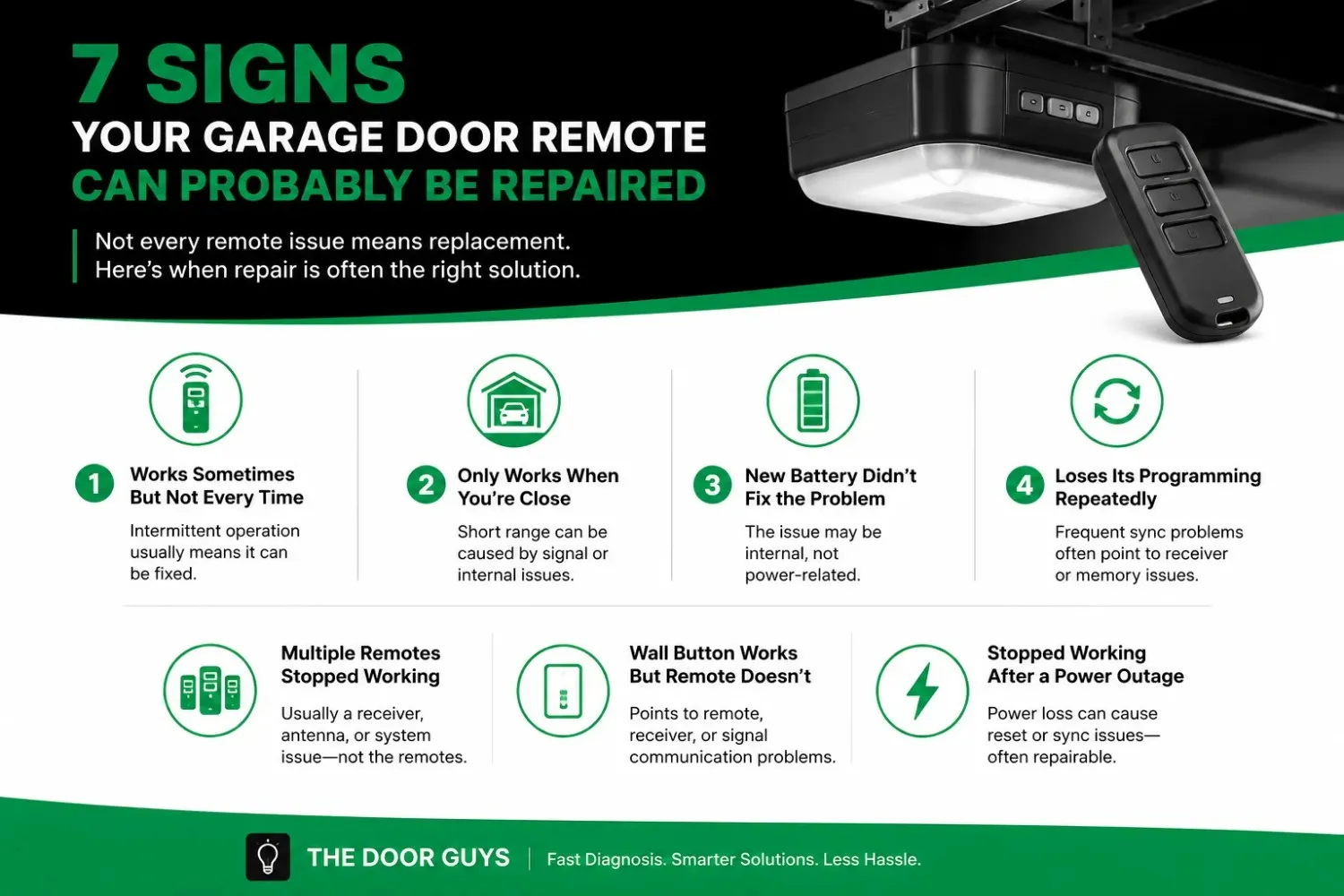
7 Signs Your Garage Door Remote Can Probably Be Repaired
1. The Remote Works Sometimes but Not Every Time
Intermittent operation is one of the strongest indicators that repair may be possible.
Many homeowners report:
“It worked yesterday but not today.”
This often points to:
- Garage remote signal problems
- Weak battery connections
- Interference from nearby electronics
- Receiver communication issues
A completely failed remote behaves differently.
2. Your Remote Only Works When You’re Close to the Garage
If you have to pull directly in front of the door before the remote responds, you may be experiencing range issues with your garage door remote. Possible causes include:
- Aging batteries
- Antenna problems
- Signal interference
- Internal transmitter wear
Many of these issues can be diagnosed without replacing the remote.
3. A New Battery Didn’t Fix the Problem
Many online guides stop at recommending a garage door remote battery replacement. Unfortunately, that’s not always enough. If the battery is new and the remote still fails, the issue may involve:
- Internal electrical contacts
- Programming errors
- Receiver communication failures
- Electronic component wear
This is where garage door remote troubleshooting becomes more important than simply replacing parts.
4. The Remote Loses Its Programming Repeatedly
Occasional reprogramming is normal. Repeated programming failures are not. Frequent garage door remote sync problems may indicate:
- Opener memory issues
- Power fluctuations
- Aging electronics
- Receiver malfunction
This is especially common after major electrical storms in Ohio.
5. Multiple Remotes Stop Working at the Same Time
This is one of the most overlooked warning signs. If every remote suddenly stops functioning, the remote itself is usually not the culprit. Instead, the issue may involve:
- Garage door opener receiver problems
- Electrical disruptions
- Control board issues
- Antenna damage
Many homeowners purchase new remotes unnecessarily when the receiver is actually failing.
6. The Wall Button Works but the Remote Doesn’t
This symptom provides a valuable clue. If the wall control operates the garage door normally, but remotes do not, technicians often focus on:
- Garage door opener remote repair
- Receiver communication
- Signal transmission
- Programming failures
The garage door system itself may be functioning properly.
7. The Remote Stopped Working After a Power Outage
Power interruptions can affect garage door electronics. Following an outage, homeowners sometimes experience:
- Garage door remote reset issues
- Lost programming
- Receiver communication errors
- Signal synchronization problems
Fortunately, these situations are often repairable.
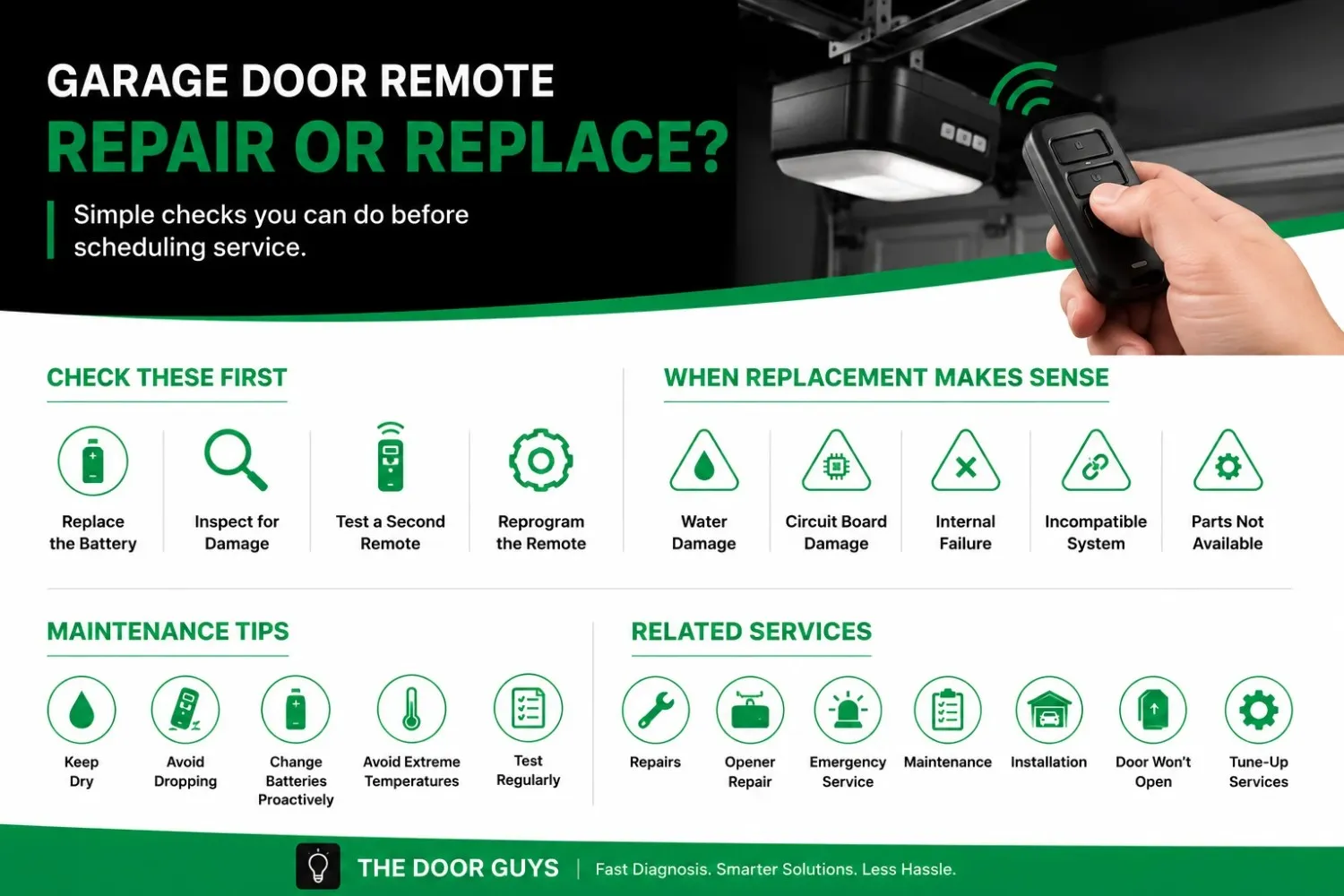
Repair or Replace Your Garage Door Remote?
| Symptom | Repair Likely | Replacement Likely |
|---|---|---|
| Weak signal | Yes | No |
| Lost programming | Yes | No |
| Remote works intermittently | Yes | No |
| Reduced operating range | Yes | No |
| Water damage | No | Yes |
| Cracked circuit board | No | Yes |
| Broken housing and electronics | No | Yes |
| Multiple remotes failing | Receiver issue | No |
This framework helps homeowners determine whether professional diagnosis is worthwhile before purchasing a replacement.
Could the Garage Door Opener Be the Real Problem?
“We’ve responded to countless service calls where homeowners purchased multiple remotes, only to discover the real issue was a failing receiver board inside the opener. If the problem extends beyond the remote itself, understanding the most common garage door repair issues can help you identify what may actually be wrong with the system.”
Common signs include:
- Multiple remotes failing simultaneously
- Successful programming attempts that don’t hold
- Inconsistent signal reception
- Wall controls are functioning normally
In these cases, problems with the garage door opener receiver are often responsible.
What We See Most Often in Central Ohio Homes
Since 1996, The Door Guys has serviced thousands of garage doors across Marion, Delaware, Powell, Dublin, Mansfield, and surrounding communities. One pattern appears repeatedly. Homeowners replace a remote because they believe it has failed.
After inspection, the actual issue turns out to be:
- Receiver communication problems
- Interference from nearby electronics
- Faulty programming
- Aging opener components
In many cases, the original remote was still functional. That experience is why we always recommend diagnosing the entire system rather than replacing parts blindly.
What You Can Check Before Scheduling Service
Before searching for garage door remote repair near me, try these basic steps.
Replace the Battery
A simple battery failure remains one of the most common causes of remote issues.
Inspect for Physical Damage
Check for:
- Cracks
- Loose buttons
- Corrosion
- Bent battery contacts
Test a Second Remote
If one remote works and another doesn’t, you’ve narrowed the issue significantly.
Reprogram the Remote
Many garage door remote programming issues can be resolved through proper synchronization with the opener. Always follow manufacturer instructions.
Common Garage Door Remote Mistakes
Avoid these common mistakes before replacing your remote.
- Buying a new remote before changing the battery
- Ignoring the opener antenna
- Programming the wrong opener button
- Assuming every remote uses the same frequency
- Replacing multiple remotes when the receiver has failed
Internal Maintenance Tips That Extend Remote Life
Simple habits can help prevent future failures.
- Keep remotes dry
- Avoid dropping them
- Replace batteries proactively
- Protect electronics from extreme temperatures
- Test operation periodically
Many remote issues develop gradually and can be caught early.
Do Universal Garage Door Remotes Work?
Many homeowners replace their original remote with a Genie universal remote, LiftMaster universal remote, or Chamberlain-compatible remote.
A universal remote can solve compatibility issues when:
- The original remote is discontinued
- Multiple garage doors need one controller
- The original remote is physically damaged
However, if the real problem is the receiver, programming, or signal interference, even a universal remote won’t solve it.
Frequently Asked Questions
Q.1 Is it possible to get a replacement garage door opener remote?
Q.2 Can cold Ohio winters affect garage door remotes?
Yes. Low temperatures can impact battery performance and occasionally affect signal transmission.
Q.3 Why is my garage door remote not working after changing the battery?
Q.4 Is it better to repair or replace a garage door opener?
Q.5 How long do garage door remotes typically last?
Lifespan depends on usage, maintenance, environmental conditions, and overall system health.
Q.6 What are common garage door remote problems?
About The Door Guys
The Door Guys have been serving Central Ohio homeowners since 1996. Our team provides professional garage door repair, opener diagnostics, maintenance, installation, and emergency service throughout Marion and surrounding communities.
Conclusion
So, can a garage door remote be repaired instead of replaced? In many cases, yes. Signal issues, programming failures, receiver communication problems, and battery-related faults are often repairable. The key is identifying the actual source of the problem before purchasing replacement equipment. If your garage door has stopped working completely after a power outage, our Emergency Garage Door Repair guide explains the immediate steps to take.
If your garage door remote has stopped working, don’t assume you need a replacement. In many cases, a battery issue, lost programming, receiver fault, or signal interference can be repaired without buying a new remote. If you’re unsure where the problem lies, a professional inspection can identify the cause and help you avoid unnecessary replacement costs.