
A garage door that closes all the way and still lets in a strip of daylight, a cold draft, or a line of ants isn’t rare; it’s one of the most common calls our technicians field once the seasons change. The hard part usually isn’t finding weatherstripping to buy. It’s figuring out which gap you’re actually looking at, because a worn seal, a sloped concrete floor, and a door that’s drifted slightly out of alignment can all look identical from the outside, even though each one needs a different repair.
This guide walks through how to find the real source of the gap, how to fix it correctly the first time, and when a sealing problem is actually pointing to something bigger. If your door is already sticking, rubbing, or closing unevenly, our sectional garage door service page covers repairs that go beyond weatherstripping.
Close the door and inspect the bottom, sides, and top edges for visible light. Replace the specific weatherstripping in that spot with a profile that matches your existing retainer; don’t assume one type fits every door. If a fresh bottom seal still leaves an opening at one corner, the floor is likely uneven, and a garage door threshold seal (installed on the concrete, not the door) will usually solve it. Cycle the door open and closed a few times afterward to confirm nothing binds.
Step One: Find Where the Gap Actually Is
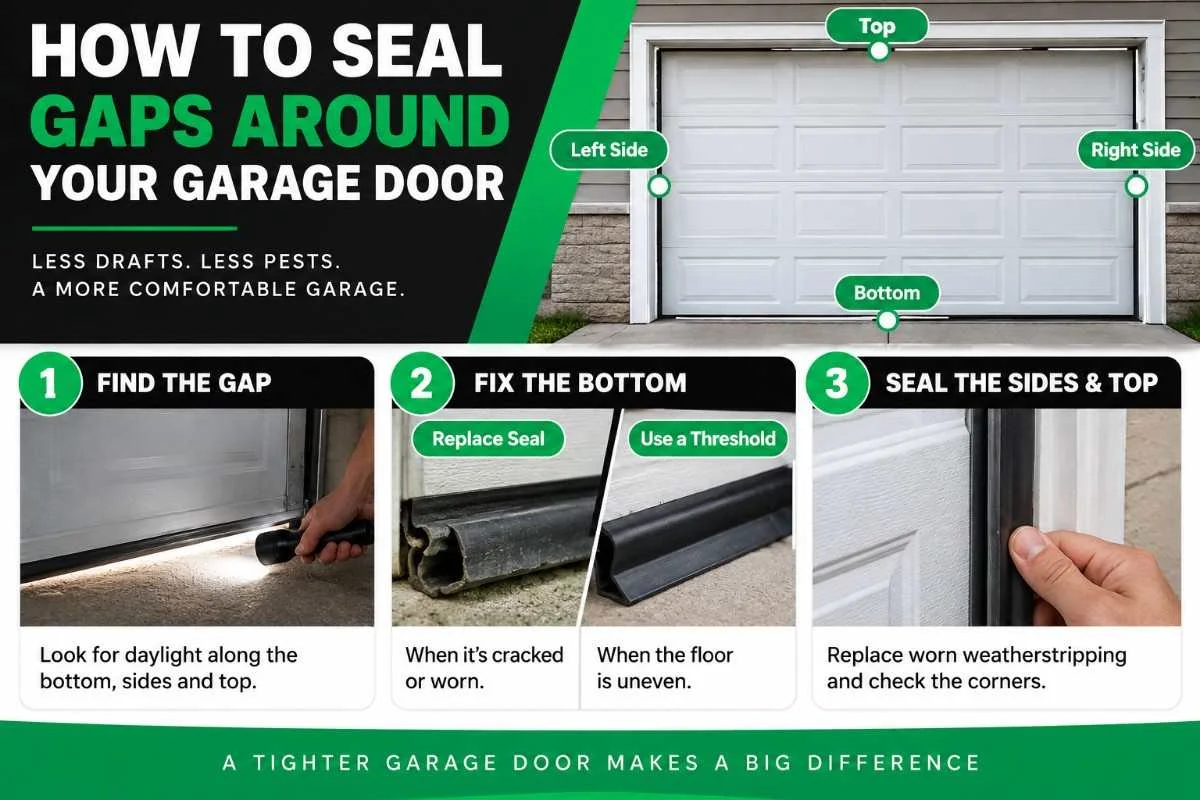
Skip the hardware store until you’ve done this. Close the door, turn off the garage lights, and walk the full perimeter from the inside. A flashlight run along the outside edge at the same time makes small openings easier to catch.
Look specifically at:
- The bottom edge: daylight between the seal and the concrete
- Both vertical sides: light between the door panels and the frame
- The header: the horizontal gap where the top of the door meets the frame
Homeowners often replace a perfectly functional bottom seal because that’s the most visible part of the door, when the real issue is a settled slab or a seal that’s simply pulled loose at one end. A five-minute inspection saves you from buying the wrong part twice.
Is It Normal to Have Any Gap at All?
A closed door should have continuous, even contact along its weather seals, not a visible line of light anywhere. That said, “sealed” doesn’t mean “crushed.” Weatherstripping needs a little flex to move with the door as it opens and closes. If a new seal is jammed too far inward, it can drag against the panel, strain the opener, or wear out months ahead of schedule. The goal is snug and flexible, not airtight and rigid.
Fixing the Bottom: Seal Replacement vs. Threshold
The bottom is where most homeowners start, and for good reason: it’s usually the first place drafts, water, and pests get in.
Replace the seal when the rubber or vinyl is cracked, flattened, brittle, or missing sections, and the gap runs fairly evenly across the width of the door. Match the new piece to your existing retainer channel; not every profile fits every track, so bring the old strip with you when shopping or measure the channel directly.
Add a threshold seal when the bottom weatherstrip is new and undamaged, but one corner still shows light. Concrete floors settle unevenly over the years; cracks, dips, and slopes are common even when the surface looks flat. Because a standard seal follows the door and not the floor, it can’t compensate for that kind of unevenness on its own. A garage door threshold seal attaches to the slab instead, giving the door seal a level surface to press against. In driveways or garages with a noticeable slope toward the door, we often recommend using both together rather than one or the other.
Closing Gaps Along the Sides and Top
If the light test shows a gap along the jambs or header rather than the floor, the perimeter weatherstripping is the piece to check. Over time, it dries out, tears, or works loose from the frame.
To replace it:
- Pull off the damaged material and clean the frame of old adhesive or debris.
- Measure the side and top runs separately.
- Install new weatherstripping so it makes light contact with the door when closed, not a tight press.
- Pay close attention to the corners, where side and top pieces meet; a sloppy transition here is a common leftover gap.
- Open and close the door a few times to confirm the new strip stays seated.
If the door itself looks crooked or the gap changes size as it travels, the weatherstripping isn’t your problem; the door’s alignment is. Our guide to common garage door problems and how to fix them covers those warning signs in more detail.
Sealing Out Drafts (Without Reaching for the Caulk Gun)
Caulk works well on stationary joints, not on a moving door edge, where it will crack and pull away almost immediately. For draft control, stick with flexible weatherstripping at every point of contact: bottom, sides, top, and a threshold if the floor calls for one. A tissue or a strip of paper held near the closed door on a windy day is a quick, low-tech way to confirm where air is actually moving.
A Simple Tool List
- Replacement weatherstripping matched to your retainer profile
- Bottom seal or threshold kit
- Tape measure and utility knife
- Screwdriver or fastener-removal tool
- Flashlight, rag, and mild cleaner
- Work gloves
- A second set of hands for longer seals
When to Stop and Call a Professional
Sealing a worn strip is a straightforward DIY task. Adjusting the door itself is not. Stop and bring in a professional if you notice the door sitting crooked, one side riding higher than the other, rollers out of the track, loose or frayed cables, a door that feels unusually heavy, or springs that look damaged. Spring and counterbalance systems hold significant tension, and they’re not something to loosen or adjust just to chase a sealing issue.
What Nearly Three Decades of Inspections Has Taught Us
We’ve been doing this kind of work since 1996, and the pattern repeats often enough that it’s worth mentioning: a homeowner replaces the bottom seal, the corner gap is still there, and the actual cause turns out to be the slab, the rollers, or the door’s closing position, not the seal itself. Rather than reaching for a thicker strip, our technicians check the floor, alignment, retainer, and tracks as a system before recommending a fix. If your home is due for a broader look, our professional garage door maintenance visits cover exactly that.
FAQs
Q.1 Can I just use foam to seal a garage door gap?
Foam isn’t built for a moving edge. It compresses once, loses shape, and won’t flex with the door the way purpose-made weatherstripping does. Save foam for stationary gaps elsewhere in the garage, not the door itself.
Q.2 I installed a new bottom seal, and there’s still a gap. Why?
Usually one of three things: the floor is uneven, the profile doesn’t match your retainer, or the door isn’t closing evenly on both sides. Check whether the gap is consistent across the width; if it’s concentrated in one corner, look at the slab before buying another seal.
Q.3 Is a threshold seal a replacement for the bottom seal?
No, they solve different problems. The bottom seal moves with the door; the threshold stays fixed to the floor. Many uneven-floor situations actually need both installed together.
Q.4 How often should garage door weatherstripping be replaced?
There’s no fixed schedule; sun exposure, temperature swings, and how often the door cycles all affect how long a seal lasts. Cracking, flattening, or a seal that no longer springs back after you press it are the signs to watch for, regardless of age.
Q.5 Can sealing gaps really help with mice and insects?
A properly fitted bottom and perimeter seal removes one of the most common entry points, yes. It won’t address every gap around a garage, though; foundation cracks, vents, and wall penetrations are separate issues worth checking too.
Will sealing my garage door actually lower my energy bill?
It can, especially if the garage sits next to living space or holds a water heater or HVAC equipment. Sealing addresses air leaks at the door itself; if the door panel is uninsulated, our insulated garage doors guide explains how much of the comfort gap comes from the door material rather than the seal.
Getting It Right the First Time
Most gap problems come down to matching the fix to the cause rather than layering on more material. Start with the light test, confirm whether the issue is at the bottom, sides, top, or the floor underneath, and install the seal built for that specific spot. If a new seal still leaves you with daylight, a stubborn draft, or water finding its way in, that’s usually a sign the door or floor needs a closer look rather than another trip to the hardware store.
If you’d rather have someone rule out the guesswork, The Door Guys has been handling garage door repair, maintenance, and installation for homeowners throughout Central Ohio since 1996.