

Three garage door opener boxes on a shelf all promise the same thing: quiet operation, smartphone control, and years of trouble-free use. The brand name on the motor housing won’t tell you which one is actually right for your door; the weight of the panel, how many times it cycles a day, what’s above your garage, and how you plan to use it will.
LiftMaster tends to be the stronger pick when you want professional installation, long-term parts support, and configurations like wall-mount jackshaft units. Chamberlain works well for a straightforward residential setup with myQ smart controls. Genie’s StealthDrive Connect line is worth a close look if quiet belt-drive performance and Aladdin Connect are your priorities. The door itself, not the logo, should drive the final call.
Why Comparing Brands Before Comparing Doors Is a Mistake
Here’s something most comparison articles skip entirely: a garage door opener doesn’t operate in a vacuum. We’ve been called out to “broken” openers more times than we can count, where the real culprit was a worn roller, a door that had drifted out of balance, or a spring losing tension, and the opener was simply the part working hardest to compensate. Swap in a brand-new unit on a door with those issues, and you’ll likely hear the same complaints within a year.
That’s why, before recommending a brand, we ask about daily cycle count, whether the garage sits under a bedroom, ceiling clearance, and how the current door has been behaving. If your existing setup is already struggling grinding, stalling, or refusing to lift it’s worth getting a professional garage door opener service diagnosis before assuming a full replacement is the fix.
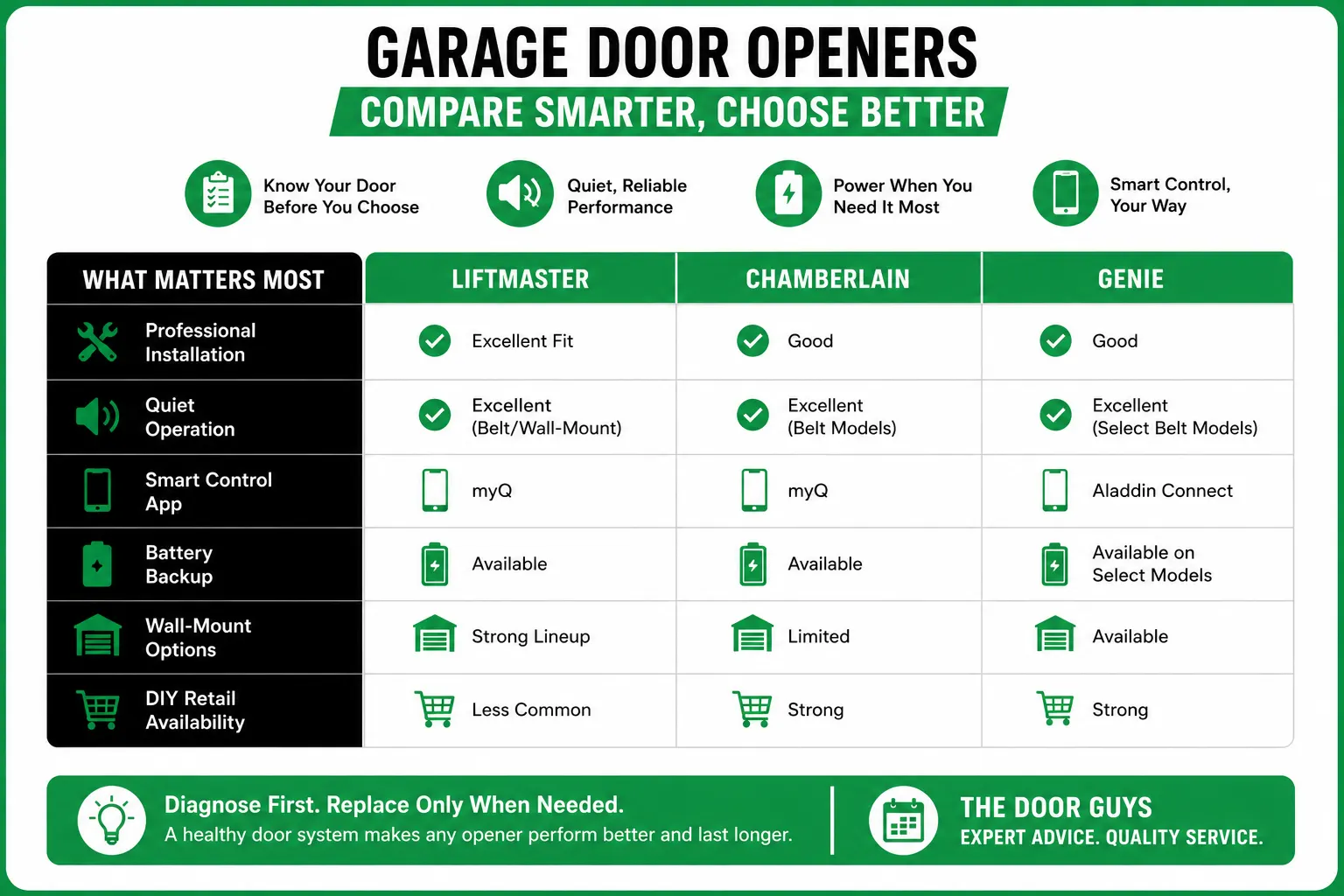
| What matters most | LiftMaster | Chamberlain | Genie |
| Professional installation | Excellent fit | Good | Good |
| Quiet operation | Excellent (belt/wall-mount) | Excellent (belt models) | Excellent (select belt models) |
| Smart control app | myQ | myQ | Aladdin Connect |
| Battery backup | Available | Available | Available on select models |
| Wall-mount jackshaft options | Strong lineup | Limited | Available |
| DIY retail availability | Less common | Strong | Strong |
Should I Get Chamberlain or LiftMaster?
This is often the toughest call, mainly because both brands come from the same parent company; the real difference isn’t quality, it’s channel. Chamberlain is built for retail and self-purchase; LiftMaster is sold and installed primarily through professional dealers, which shows up most when a job needs something beyond a standard ceiling-mount setup.
For a typical single-car or double-car door with normal daily use, a current Chamberlain belt-drive opener holds up fine: quiet motor, myQ connectivity, and battery backup on qualifying models. Where LiftMaster earns its premium is in trickier installs: low headroom, oversized doors, or homes wanting a cleaner ceiling with a wall-mounted unit.
Rather than defaulting to “LiftMaster is better,” ask:
- How heavy is the door, and how often does it cycle?
- Is there living space directly above the garage?
- Do you need the ceiling for storage?
- Will you want a technician familiar with the model down the road?
Those answers narrow the decision far faster than any spec sheet.
LiftMaster vs Genie: More Than a Budget Alternative
Genie gets unfairly boxed in as the “value” option, but that undersells current models. The StealthDrive Connect 7155 pairs a steel-reinforced belt with a DC motor, built-in Aladdin Connect, and battery backup positioned specifically for homes where a quiet garage matters, like an attached space near bedrooms or a home office.
Where the comparison gets real isn’t at install day, though; it’s two or three years later. Ask who’s servicing the unit, whether parts are easy to source locally, and whether your installer has actually worked on that specific model before. An opener that’s cheap to buy but hard to service isn’t actually the better deal.
Genie vs Chamberlain: Don’t Let the App Decide For You
The myQ vs. Aladdin Connect debate gets more attention than it deserves. Both apps do the core job of remote access, activity alerts, and the ability to grant entry without handing out a physical remote competently.
A better question than “which app is nicer” is: will you actually use the smart features, and is the opener itself sized correctly for your door? A well-reviewed app attached to an underpowered or mismatched opener is still a poor installation. Match the hardware to the door first; the app is a bonus, not the deciding factor.
Best Belt Drive Garage Door Opener for a Quiet Home
If noise is the main concern, belt-drive is the right starting point across all three brands. LiftMaster’s belt-drive DC motor line is built to cut noise and vibration for homes with living space above or beside the garage. Genie’s StealthDrive follows the same approach with a reinforced belt and DC motor. Chamberlain offers comparable belt-drive, battery-backed models at the consumer level.
One caution worth repeating: the opener isn’t always the noise source. Loose hinges, worn rollers, and a door that’s out of balance can make even a premium belt-drive unit sound rough. If you’ve had ongoing humming or grinding on an existing LiftMaster unit, our breakdown of a LiftMaster opener humming but not opening walks through the likely causes before you spend on a replacement.
Battery Backup and Cold-Weather Reliability
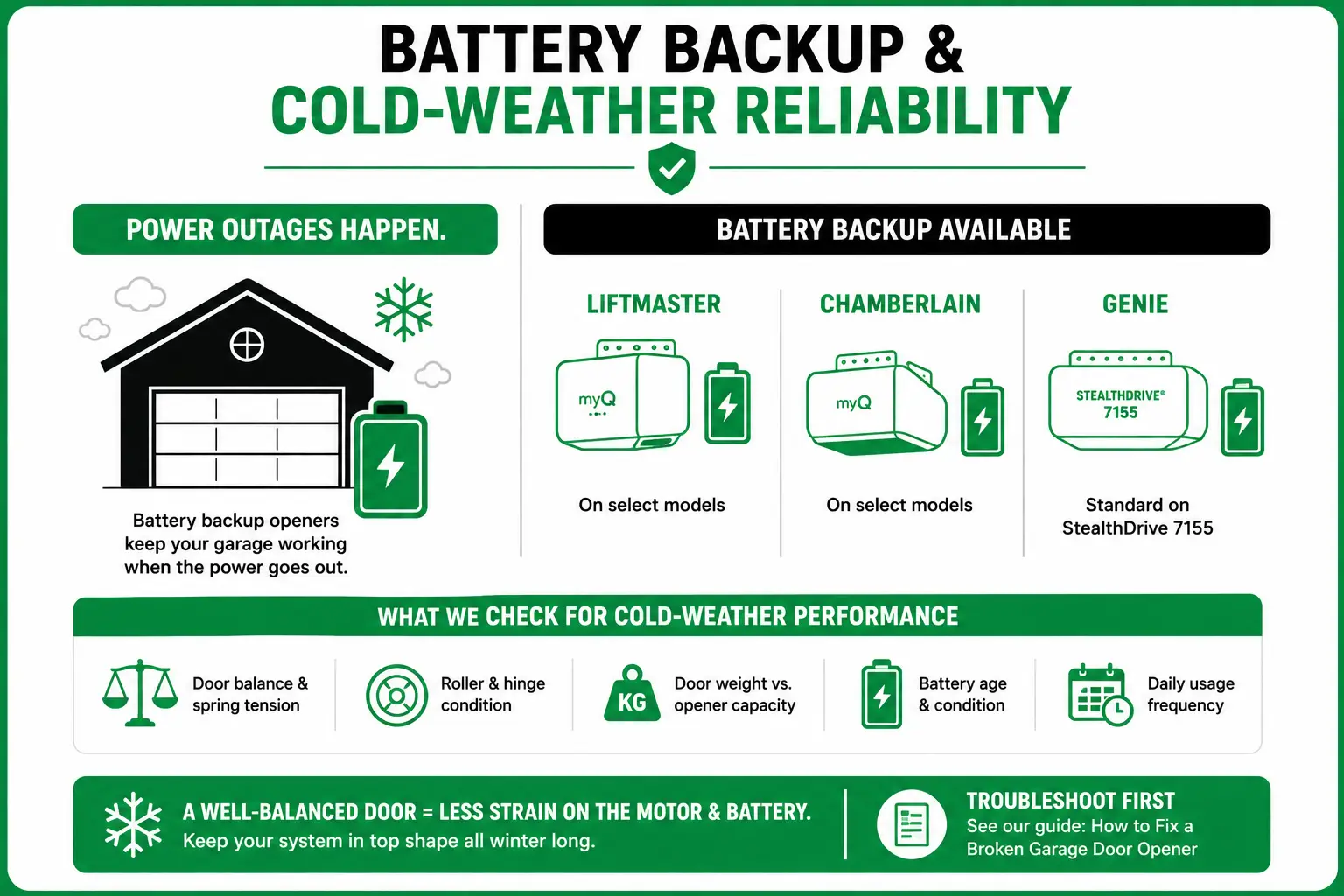
A power outage shouldn’t mean you’re stuck outside your own garage. All three manufacturers offer battery-backup configurations on select models. Genie’s StealthDrive 7155 includes it standard, and current LiftMaster and Chamberlain lines offer it depending on the tier.
But “cold-weather ready” marketing only goes so far. What we actually check during winter service calls:
- Door balance and spring tension
- Roller and hinge condition
- Overall door weight relative to the opener’s rated capacity
- Battery age and condition
- How often the door is used daily
A well-balanced door puts far less strain on the motor, battery included. If your current opener has been stopping partway or struggling to close, that’s often a door-system issue rather than an opener failure. Our guide on how to fix a broken garage door opener is a useful next step before replacing anything.
When a Wall-Mount Jackshaft Opener Is Worth Considering
A jackshaft opener mounts beside the door and drives it through the torsion bar, instead of hanging from the ceiling. LiftMaster’s 8500W is a common choice here, designed to free up overhead space while reducing vibration.
This setup makes sense if you have low headroom, want the ceiling clear for storage, or have a high-lift or unusual track configuration. It’s not automatically the “better” choice for every garage; it’s the better choice for specific ones.
Which Garage Door Opener Lasts Longest?
No brand can honestly claim to outlast the others in every scenario. Lifespan comes down to the model, door weight, balance, cycle frequency, and how consistently the whole system is maintained. A household opening the garage twice a day puts far less wear on a motor than one cycling it a dozen times.
Our approach after nearly three decades of service calls: pick the opener that matches the door and how you actually use it, then choose the brand within that category.
Choose LiftMaster when professional installation, long-term parts support, and configuration flexibility (like wall-mount jackshaft units) matter most. Choose Chamberlain for a straightforward residential setup with reliable myQ connectivity. Choose Genie when a quiet belt-drive system with Aladdin Connect and battery backup checks your boxes.
Ahead of all three, though: have the door itself inspected. No opener, regardless of brand, fixes a door that’s out of balance or dragging on the track. If you’re weighing an opener replacement alongside a larger door upgrade, our overhead sectional doors page covers what to look for there too.
Why This Comes From Experience, Not a Spec Sheet
We’ve been working on garage door systems since 1996, which means we’ve installed, repaired, and serviced all three of these brands across homes with wildly different doors, climates, and daily habits. That hands-on pattern where openers fail, why they fail, and what actually fixes it is what shaped this guide, not a features comparison pulled from marketing pages.
If you’d rather have someone look at your specific door and use case than guess between three boxes on a shelf, reach out to The Door Guys garage door experts for a straightforward recommendation.
FAQs
Q.1 How do I know if my current opener is actually the problem, or if it’s the door?
Symptoms like humming, stalling, or struggling to lift usually start with the door balance, springs, rollers, or track before they’re an opener issue. A quick inspection can rule that out before you spend on a new unit.
Q.2 Does a stronger motor mean a longer-lasting opener?
Not necessarily. Horsepower matters less than whether the opener is correctly matched to your door’s weight and how often it cycles. An oversized motor on a poorly balanced door still wears out early.
Q.3 Can I switch from a chain-drive to a belt-drive opener without changing anything else?
In most cases, yes, though headroom, mounting rail length, and existing wiring can affect the swap. It’s worth confirming compatibility with your specific door and garage layout first.
Q.4 Is a wall-mounted jackshaft opener harder to install than a standard ceiling opener?
It’s a different installation process, generally suited to professional setup, especially when working around an existing torsion bar system or unusual track configuration.
Q.5 Do smart features like myQ or Aladdin Connect work if my internet goes down?
Basic remote and keypad operation still works locally; only the remote smartphone access and alerts depend on a working internet connection at the garage.
Q.6 How often should a garage door opener be serviced, regardless of brand?
An annual check of balance, rollers, hinges, and hardware helps most openers LiftMaster, Chamberlain, or Genie run quieter and last longer, since the door system affects opener wear more than the brand does.