

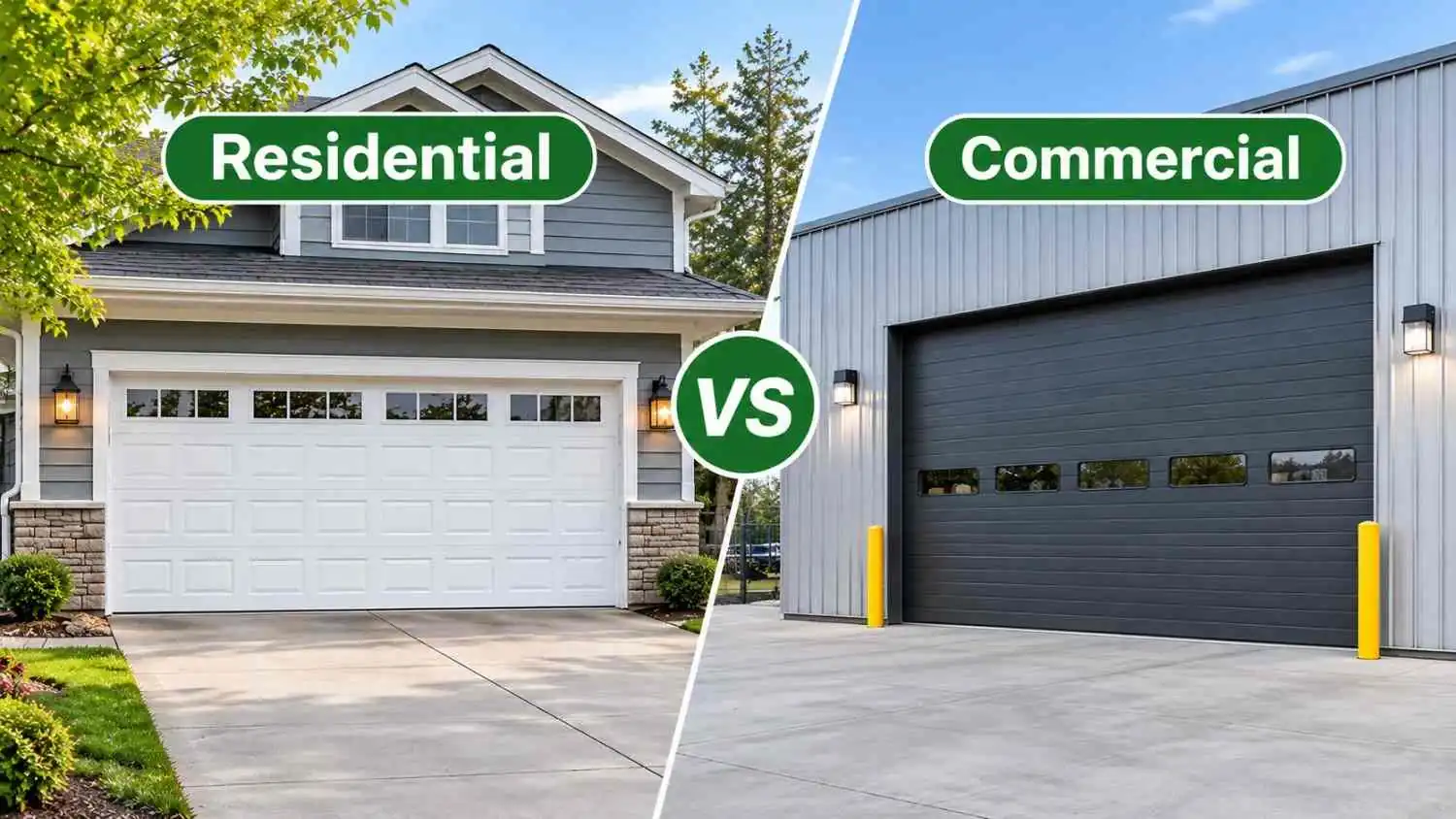
You have probably noticed it: the overhead door at a body shop closes fast and solid, while your own garage door groans its way up and down. They are built for different jobs, and the residential vs commercial garage door Ohio choice comes down to how hard the door works. A home door cycles about five times a day. A shop or warehouse door can cycle fifty times or more. This guide shows what changes, when it matters, and how to choose without overpaying.
At a Glance: Residential vs Commercial
|
Factor |
Residential |
Commercial |
|
Typical use |
Home garage, about 4 to 6 cycles a day |
Shops, warehouses, docks: 20 to 100+ cycles a day |
|
Opening size |
8 to 9 ft wide (single) or 16 ft (double) |
Often over 16 ft wide or 8 ft tall |
|
Spring rating |
About 10,000 cycles |
50,000 to 100,000+ cycles |
|
Opener |
Chain, belt, or screw drive |
Jackshaft, trolley, or hoist |
|
If it breaks |
An inconvenience |
Lost work hours and an unsecured building |
What Is Considered a Commercial Garage Door?
No single size makes a door commercial. Three things decide it: how often it is used, how big the opening is, and what the building is used for. A door that trucks or forklifts pass through, or that sits on a non-home building, usually needs commercial parts even if it looks like a home door. Our come in both classes, so two similar-looking doors can be built very differently. For normal home dimensions, see our standard garage door sizes guide.
Which Door Fits Your Property?
Start with how often the door opens each day:
- Under about 5 cycles a day: a quality residential door is the right fit.
- 10 to 15 cycles a day: choose a high-cycle or commercial-grade system.
- 20+ cycles a day, trucks, or forklifts: go fully commercial.
Fire separation is a separate code question, covered in our fire-rated garage door guide. Always match the springs, track, and opener as one system.
Can a Business Use a Residential Door?
Sometimes, yes. The building’s label does not decide it; daily cycles, door weight, and traffic do. A residential-style door can work well for a low-traffic office or storage garage under about 5 cycles a day, a boutique, salon, or café where looks, windows, and quiet operation matter, or a small business with one or two vehicles and no forklift traffic. It is the wrong choice for loading docks, shops with trucks or forklifts, or any door past roughly 20 cycles a day, because the springs, track, and opener wear out far sooner than they should.
Residential vs Commercial Garage Doors: Key Differences
Cycle Ratings and Daily Use
A cycle is one open plus one close, so a trip out and back counts as two cycles. Most home springs ship rated for about 10,000 cycles, while commercial systems start at 50,000. Your daily cycles decide how fast that rating gets used up.
Count your own cycles in 3 steps
- Tally every open and close for one normal week.
- Divide the total by 7 to get cycles per day.
- Divide your spring’s rated cycles by that number to estimate how many days it should last.
Spring Systems
The spring, not the opener, does most of the lifting, which is why a broken spring makes a door feel impossibly heavy. Torsion springs, a coil that stores twisting force on a bar above the door are standard on commercial doors, while some older homes still use extension springs along the tracks. Replacement is a job for a trained tech. See how long garage door springs last.
Hardware and Track
Track thickness, hinge count, and roller type are the specs buyers rarely ask about. Commercial kits use thicker track, extra hinges, and sealed ball-bearing rollers made for vehicle bumps and constant movement. A light home kit on a wide opening is a common reason rollers jump the track.
Opener Types
Match the opener to the door’s shape. Jackshaft units mount on the wall beside the door, trolley units ride a rail above it, and hoist units drive rolling steel doors. Whatever you choose, look for UL 325 entrapment protection such as photo-eyes, which stop the door if something is in its path. Learn why photo-eyes stop working before you assume the opener has failed.
Ohio Code and Wind Load Requirements
Commercial doors fall under the Ohio Building Code (2024 edition, effective March 1, 2024, based on the 2021 International Building Code). Large openings need strong framing and a wind-pressure rating for your site. Permit rules vary by city, so ask your local building department first.
Service Intervals
A home door needs a check about once a year, while a commercial door needs one roughly every three months, or monthly above about 50 cycles a day. Ohio’s freeze-thaw swings and road salt rust cables and thicken lubricant, so skipped visits cost more than they save. See how cold weather stalls doors to know what to check each winter. Our maintenance and repair team can set the schedule.
Warranty Coverage
Check three things in the fine print: whether business use is covered, whether springs and openers are included, and whether service records are required. Many commercial warranties tie coverage to cycle counts and proof of regular service, so keep every receipt.
Downtime Impact
To estimate it, multiply idle crew hours by your hourly labor cost, then add late-delivery penalties and the risk of leaving the building unsecured overnight. One lost day often costs more than the price gap between door grades, so work with a Central Ohio door team that carries common parts on the truck.
Insulation
Insulation is the foam layer in the panels. In a heated shop it protects products and saves heat, and commercial panels weigh more, so the springs and track must be sized for them. For the home side, see why Ohio homeowners choose insulated garage doors.
When Does a Home Need a Commercial-Grade Door?
Most homes never do, but these situations push a home door into commercial territory:
- RV or boat garage: tall, wide openings and heavy panels need heavier springs and track.
- Large workshop: constant in-and-out traffic uses up home-grade parts quickly.
- Home business with deliveries: more daily cycles than a household ever creates.
- Oversized or custom opening: very wide or tall doors exceed standard home kits.
- Heavy equipment storage: tractors and lifts bump panels and track.
These are case-by-case calls, so have a tech measure the opening and count your cycles before you decide.
Which Costs More Over Time: A Cheap Door or the Right Door?
Upfront price tells only half the story. This illustrative five-year comparison covers a shop door cycling 50 times a day, using round assumed numbers (a $250 repair visit plus $120 of idle crew time per visit). Swap in your own quotes to repeat the math.
|
Home-grade door |
Commercial-grade door |
|
|
Door and install (assumed) |
$2,000 |
$4,500 |
|
Spring life at 50 cycles a day |
About 7 months |
2.7 to 5.5 years |
|
Spring replacements in 5 years |
About 9 |
0 to 1 |
|
Repair cost at $370 per visit |
About $3,330 |
$0 to $370 |
|
Five-year total |
About $5,330 |
About $4,500 to $4,870 |
The math ignores worn openers, track, and the downtime between visits, all of which push the home-grade total higher. At 5 cycles a day the result flips: a home spring lasts about five and a half years, so the cheaper door wins.
What Mistakes Should You Avoid?
Most costly door problems trace back to a few avoidable buying and upkeep mistakes. Here is what each one looks like and how to avoid it.
- Mixing parts – Heavy commercial springs on a light opener, or the reverse, create new problems. Springs, track, and opener are sized to work as one system, so a mismatch strains the weakest part first. Buy them as a matched set, with torsion springs sized for your door and an opener that can handle its weight.
- Reusing worn track on a new door – Old track and hinges can wear out the new panels. Bent or rusted track makes rollers bind, and that stress passes straight into new panels. Have a tech inspect or replace the track and hinges during installation.
- Ordering before measuring headroom – Tight headroom may call for a high-lift system instead of a standard door. Measure the clear space above the opening before you pick a door, because standard track needs room to curve overhead.
- Guessing your daily cycles – A spring rated for 10,000 cycles wears out fast on a door that cycles 50 times a day. Count a normal week first (see the 3-step method above), then choose a spring rating to match.
- Skipping scheduled service – Ohio’s freeze-thaw swings and road salt rust cables and thicken lubricant. A yearly check for a home door, and roughly every three months for a commercial door, catches small wear before it becomes a breakdown. Many commercial warranties also require service records.
Frequently Asked Questions
Q1. What size garage door is considered commercial?
No code sets one size. Openings wider than about 16 feet or taller than 8 to 10 feet, such as 12×12 or 14×14 truck doors, usually need commercial hardware. Standard home sizes are listed in our standard garage door sizes guide.
Q2. How much does a commercial garage door cost?
Cost depends on size, insulation, operator, and cycle rating. Basic commercial sectional doors start in the low thousands installed, while large rolling steel or high-speed systems cost far more. For what drives price, see our Ohio installation cost guide.
Q3. Who makes the best commercial garage doors?
Well-known makers include Raynor, Overhead Door, Clopay, Amarr, Wayne Dalton, and Haas. The best choice depends on cycles, insulation, wind rating, and local service support. We install Raynor, so ask any installer for brand-by-brand specs.
Q4. How much should I budget for a new garage door?
Many Ohio homeowners budget roughly $1,200 to $2,500 for a single door and $2,000 to $4,500 or more for a double, installed. Insulation, windows, and openers add cost. Commercial budgets start higher, so get a written estimate for your opening.
Q5. What’s the average lifespan of a garage door?
Residential doors typically last 15 to 30 years, with springs often lasting 5 to 10 years at normal home use. Commercial lifespan depends on cycle count and service. See our garage door lifespan guide for warning signs.
Get the Right Door for Your Property
Not sure which side of the residential vs commercial garage door Ohio line your building falls on? Tell us your opening size and daily cycles, and we will recommend a system, so request a free estimate from our Marion or Lewis Center team, with same-day emergency service available.