
Your garage door cable is frayed or slightly off-track; a repair may be all you need. But if the cable has snapped, both cables are worn, or the door is older than 10 years with multiple issues, replacement is almost always the smarter, safer option. When in doubt, get a professional inspection. Cables are under serious tension, and guessing wrong can be dangerous.
You press the button, and instead of rising smoothly, your garage door tilts awkwardly to one side, one corner dragging while the other rises. Or maybe there’s a sudden metallic snap followed by a loud slam. These aren’t random quirks. They’re classic signs that your garage door cables are failing, and ignoring them even for a day or two can turn a $200 repair into a $600+ repair involving your tracks or opener.
As local garage door specialists who have been serving central Ohio homeowners since 1996, we’ve walked through this exact scenario hundreds of times. Whether you need a simple garage door fix or a complete cable replacement, this guide cuts through the noise and gives you a clear, honest framework to help you decide without the guesswork.
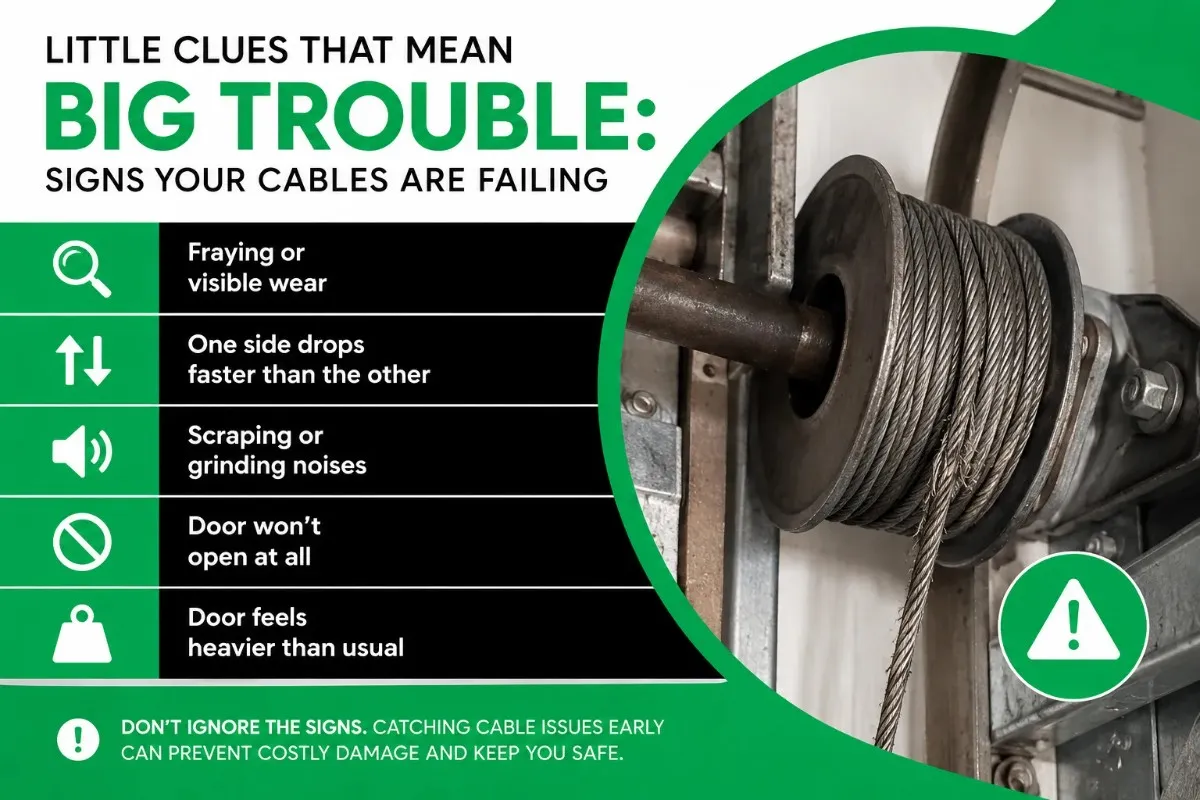
Little Clues That Mean Big Trouble: Signs Your Cables Are Failing
Most homeowners don’t think about cables until something goes wrong. But your garage door cables work hard every time the door moves, helping balance a door that can weigh anywhere from 130 to 400 pounds alongside the drums. Because they play such a critical role in safe operation, damaged or worn cables are also one of the common signs a garage door needs repair, even if the door still appears to function normally.
Here’s what to watch for:
Fraying or visible wear. Look near the drum (the spool at the top corner of your door). If you see individual wire strands separating or unraveling, that cable is past its prime. Don’t touch it, just note it.
One side drops faster than the other. Uneven movement almost always points to a cable that’s lost tension or slipped off the drum. The door essentially becomes lopsided.
Scraping or grinding noises. A cable that’s off-track or tangled can drag against the door panels or track, creating sounds that get worse every cycle.
The door won’t open at all (sudden drop): A snapped cable is dramatic. The door may slam down or refuse to budge, and the opener may hum without the door moving. (If your opener hums but nothing happens, this post on LiftMaster openers humming but not opening can help you rule out other causes.)
The door feels heavier than usual: Even with the opener doing the work, a failing cable shifts load onto the motor in ways that shorten its life significantly.
Why Ohio’s Weather Makes This Worse
In central Ohio, temperature swings between winter and summer can exceed 80°F. That expansion and contraction stress metal cables, drums, and pulleys constantly. Add humidity, road salt, and moisture that pools in garages, and you have a recipe for accelerated corrosion. A cable that looks fine in spring may be significantly weaker by fall.
Safe DIY visual check: With the door fully closed, look at both cables along the sides of the door; they should be tight, with no loops, kinks, or visible fraying. If anything looks off, stop there. Do not attempt to adjust or touch the cables; the tension involved can cause serious injury.
What Causes Cables to Fail?
Understanding the cause helps you avoid repeat failures:
- Age and cycle count. Most cables last 5 to 15 years, depending on how frequently the door is used. A door cycled 4–5 times daily wears cables faster than one used once or twice.
- Spring imbalance: When a spring loses tension or breaks, the cable picks up extra load it wasn’t designed to handle. This is one reason why how long your garage door springs last matters directly to cable health.
- Lack of lubrication: Dry drums and pulleys create friction that slowly grinds through cable strands.
- Rust and corrosion Especially common in Ohio’s humid winters. Coated cables resist this better than bare steel.
- Improper installation can also cause premature wear. Cables that are wound incorrectly or set to the wrong tension will wear unevenly.
- Physical impact: Backing into the door, debris caught in the track, or a hard manual pull can kink or snap a cable instantly.
Garage Door Cable Repair vs. Replacement: Which Does Your Door Need?
This is the core question, and the answer depends on more than just the cable itself.
When Repair Makes Sense
A cable repair (restringing, tension adjustment, or drum re-seating) is usually the right move when:
- The cable slipped off the drum, but is otherwise undamaged
- There’s minor, isolated fraying near one end, with the rest of the cable intact
- The door was recently serviced, and the rest of the system is in good shape
- The door is under 7–8 years old with a reasonable cycle history
In these cases, a technician can reseat or restring the cable, adjust tension, and get you back in business quickly.
When Replacement Is the Better Choice
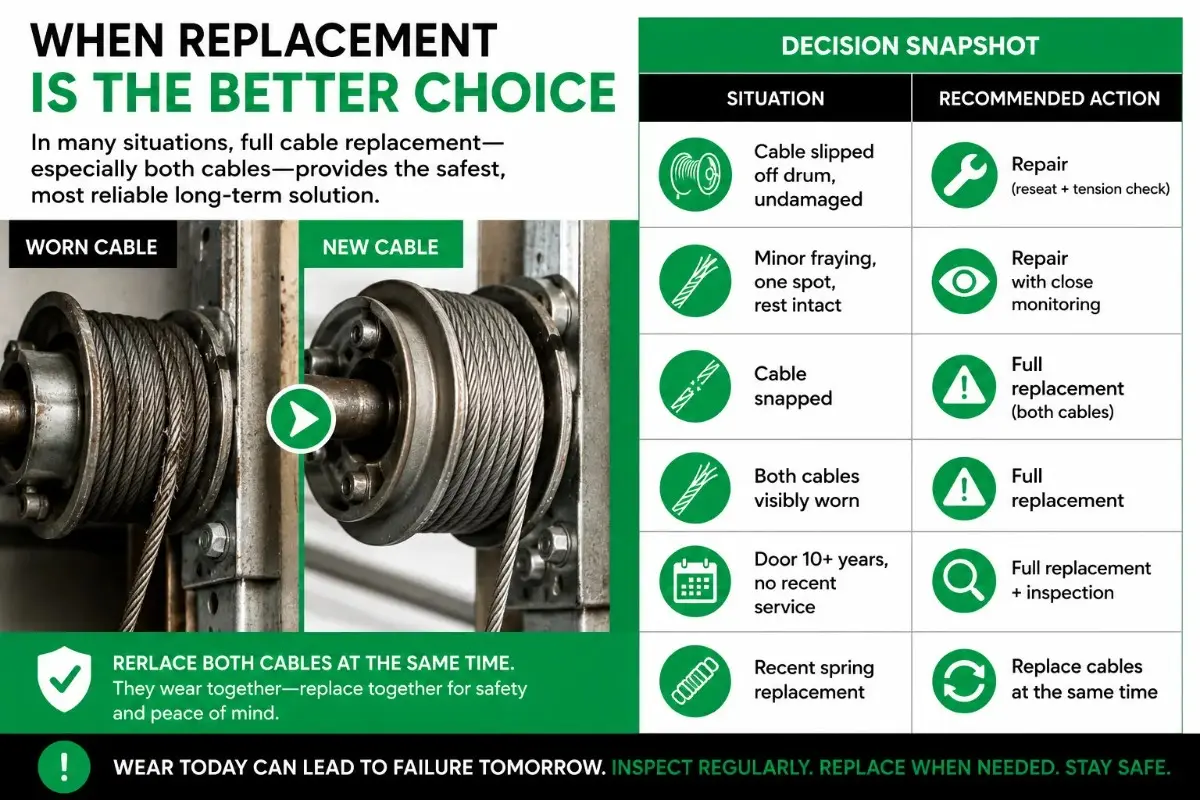
Full cable replacement (and often both cables at once) makes more sense when:
- One cable has snapped completely
- Both cables show wear, even if only one has failed. Cables age together, and replacing just one leaves the other ready to fail weeks later.
- The cable is visibly rusted, kinked, or the strands have separated at multiple points.
- The door is 10+ years old and hasn’t had a professional tune-up in several years.
- You’re already replacing springs or drums at that point; swapping cables adds minimal labor cost and significant peace of mind.
Replace both cables at the same time. This is the same logic as replacing both tires on the same axle. Cables wear at similar rates, and the labor cost to replace the second one later is the same as doing both together now.
| Situation | Recommended Action |
| The cable slipped off the drum, undamaged | Repair (reseat + tension check) |
| Minor fraying, one spot, rest intact | Repair with close monitoring |
| Cable snapped | Full replacement (both cables) |
| Both cables visibly worn | Full replacement |
| Door 10+ years, no recent service | Full replacement + inspection |
| Recent spring replacement | Replace cables at the same time |
Cables rarely fail alone. When we go out on a cable service call, we almost always find at least one other issue: worn rollers, a drum that’s shifted, or a worn garage door nearing the end of its service life. A full system inspection at the time of cable work often saves homeowners a second service call within six months.
What Types of Garage Door Cables Are There?
Not all cables are the same. Here’s what matters when choosing:
- Standard lift cables: The most common type, used with torsion or extension spring systems. Usually galvanized steel.
- Aircraft-grade cables: Thicker, higher strand count, and rated for heavier doors or high-cycle use. Worth the upgrade if your door runs frequently.
- Coated vs. uncoated: Vinyl- or nylon-coated cables resist moisture and rust significantly better. In Ohio’s climate, coated cables are worth every extra dollar.
- Diameter/gauge sized to the weight and height of your door. A 1/8″ cable is fine for a standard single door; heavier or taller doors may need 9/32″ or larger. Getting this wrong means premature wear or unsafe tension. A professional can measure and specify the right cable for your exact door.
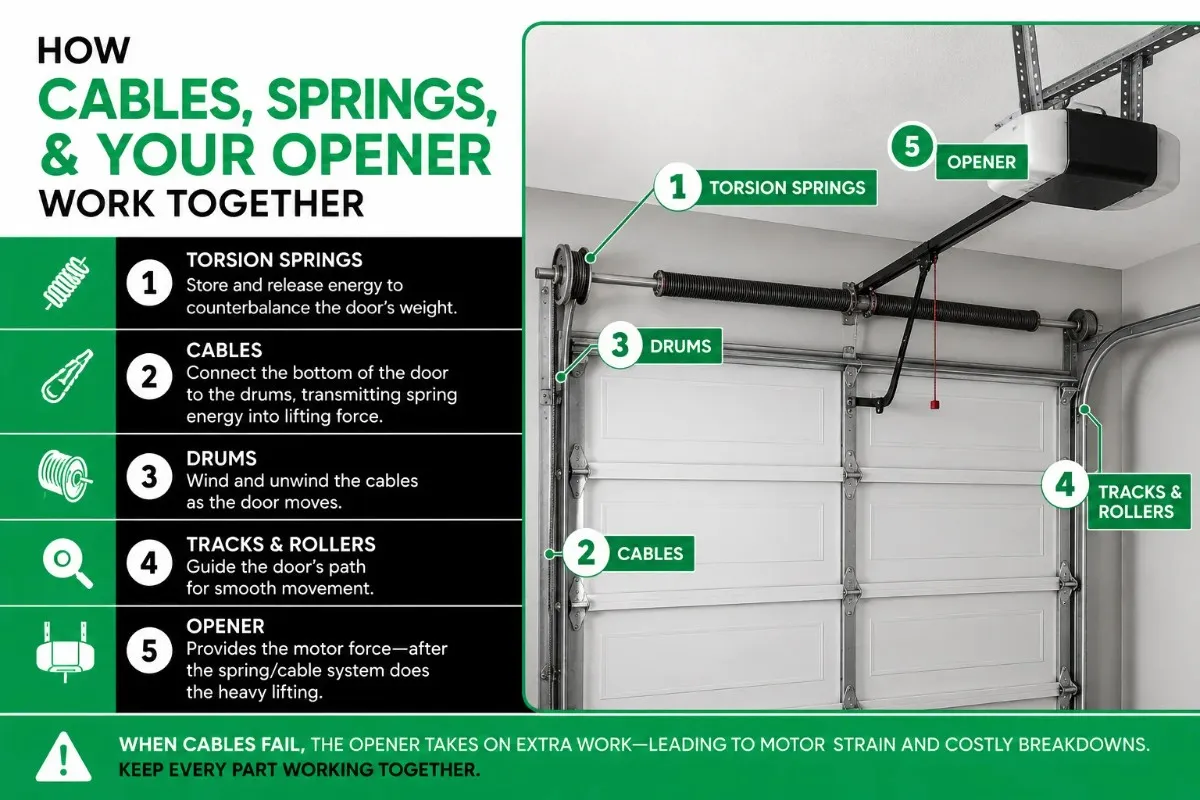
How Cables, Springs, and Your Opener Work Together
Your garage door isn’t just a panel on a track. It’s a balanced mechanical system where every part depends on the others:
- Torsion stores and releases energy to counterbalance the door’s weight
- Cables connect the bottom of the door to the drums, transmitting that energy into a lifting force.
- Drums wind and unwind the cables as the door moves
- Tracks and rollers guide the door’s path
- The opener provides the motor force, but only after the cable system does the heavy balancing work.
When cables fail, the opener suddenly has to do the work of both the motor and the springs. That’s how a small cable problem leads to a burned-out opener motor. For more on how these parts age together, our post on the lifespan of a garage door breaks it down clearly.
Cost Reality: What to Expect
We intentionally keep specific price ranges general; costs vary significantly based on door size, cable type, and whether a full inspection uncovers additional parts that need attention. What we can tell you:
- Single cable repair is typically the most affordable option
- Replacing both cables costs a bit more but is nearly always worth it
- Cable replacement bundled with spring or drum work often saves on labor vs. separate visits
- Factors that affect your quote: door height, cable grade, whether drums or rollers need work, and how quickly you need service
For a realistic sense of what garage door work costs in our area, our garage door repair cost guide for Ohio walks through the major cost drivers honestly.
Will homeowners’ insurance cover it? Rarely, if the cause is normal wear and tear, which is the cause of most cable failures. If a cable snapped because something hit your door or caused sudden physical damage, it may be worth checking your policy. Call your provider before assuming either way.
We offer free estimates with no pressure. Call us at (740) 383-1234 or contact us online to find out exactly what your door needs.
Why DIY Cable Repair Is Genuinely Dangerous
We understand the impulse to handle things yourself. But garage door cables are constantly under hundreds of pounds of spring tension. Releasing that stored energy incorrectly or accidentally can cause a cable to whip, a garage door to snap, or a door to drop without warning.
What you can safely do:
- Visually inspect cables from a distance with the door closed
- Note symptoms (which side, what sounds, when it started)
- Disconnect the opener and do not manually force the door
What requires a pro:
- Anything involving touching, unwinding, or adjusting cables.
- Reseating a cable that slipped off a drum
- Replacing or tensioning any part of the cable system
Our team offers same-day service for cable failures because a door that won’t close is a security issue, not just a convenience problem. If you’re dealing with a sudden cable failure, see our garage door emergency guide for steps to take before we arrive.
How to Prevent Cable Problems Before They Start
The best cable repair is the one you never need. Here’s what keeps cables healthy longer:
- Annual professional tune-up includes lubrication, tension check, and visual inspection of all components. Most issues are caught here before they become failures.
- Lubricate cables and pulleys. A light spray of garage door lubricant (not WD-40) on drums, pulleys, and cable contact points every 6 months helps significantly.
- Balance test: Disconnect the opener and manually lift the door to waist height. It should stay put. If it drops or rises on its own, your springs are out of balance and putting extra load on your cables.
- Replace old parts proactively. If your springs are 10+ years old, your cables are likely living on borrowed time, too.
Frequently Asked Questions
Q.1 What are the signs of a broken garage door cable?
Uneven door movement, visible fraying near the drum, one side of the door tilting, scraping noises, or a door that won’t open at all are the most common signs. A suddenly heavy door is also a red flag.
Q.2 Do I need to replace both garage door cables at once?
Yes, in almost every case. Cables age at the same rate, and replacing just one means the other is likely close behind. Doing both at the same time saves on labor and prevents a second failure soon after.
Q.3 How long do garage door cables last?
Typically, 5 to 15 years, depending on usage frequency, environment, and whether they’ve been properly maintained. High-cycle doors in Ohio’s climate may see wear on the shorter end of that range.
Q.4 What size garage door cable do I need?
Cable diameter depends on your door’s weight and height. Standard residential doors typically use 1/8″ cables, but heavier or taller doors require a larger gauge. A technician should measure your door and counterbalance system to specify the correct cable; using the wrong size can cause premature wear and create safety risks.
Q.5 What happens if I keep using a damaged cable?
Continued use with a frayed or failing cable puts stress on the opener, counterbalance system, and tracks. The door can drop suddenly, the opener motor can burn out, and the tracks can bend from uneven loading. A small repair becomes a much larger repair very quickly.
Q.6 Will homeowners’ insurance cover garage door cable repair?
Usually not for normal wear and tear. Some policies cover sudden accidental damage. Check your specific policy and call your provider before making assumptions.
Q.7 How do I know if it’s the cable or the spring that’s broken?
Springs usually make a loud bang when they break, and the door will feel extremely heavy manually. Cable failures tend to show up as uneven movement or one side dropping. That said, the two often fail together. An inspection will identify exactly what’s going on.
Get the Right Solution for Your Garage Door
A failing garage door cable isn’t a “wait and see” situation. The longer you run a compromised cable, the more damage spreads to drums, tracks, and your opener. If you caught it early with minor fraying and the system is otherwise solid, a repair is often enough. If the cable has snapped, both cables are worn, or the door is aging with multiple small issues, replacement is the smarter investment.
Either way, this isn’t a job for guesswork or a DIY repair, and it’s not one you should delay. As the local garage door specialists central Ohio has trusted since 1996, The Door Guys brings honest assessments, same-day service, and no-pressure free estimates to every job.